Have you ever paused mid-sentence wondering if you should write “accept” or “except”? 🤔 You’re not alone!
These two words sound almost identical, but their meanings couldn’t be more different.
People often search for “accept or except” because they want to avoid common grammar mistakes that can change the meaning of a sentence entirely.
👉 Whether you’re writing an email, school essay, or social media caption, knowing when to use accept vs except can make your writing look polished and professional.
This guide will give you a quick, clear answer — followed by examples, origin, usage trends, and expert tips to help you remember the difference easily! 💡
💬 Accept or Except – Quick Answer
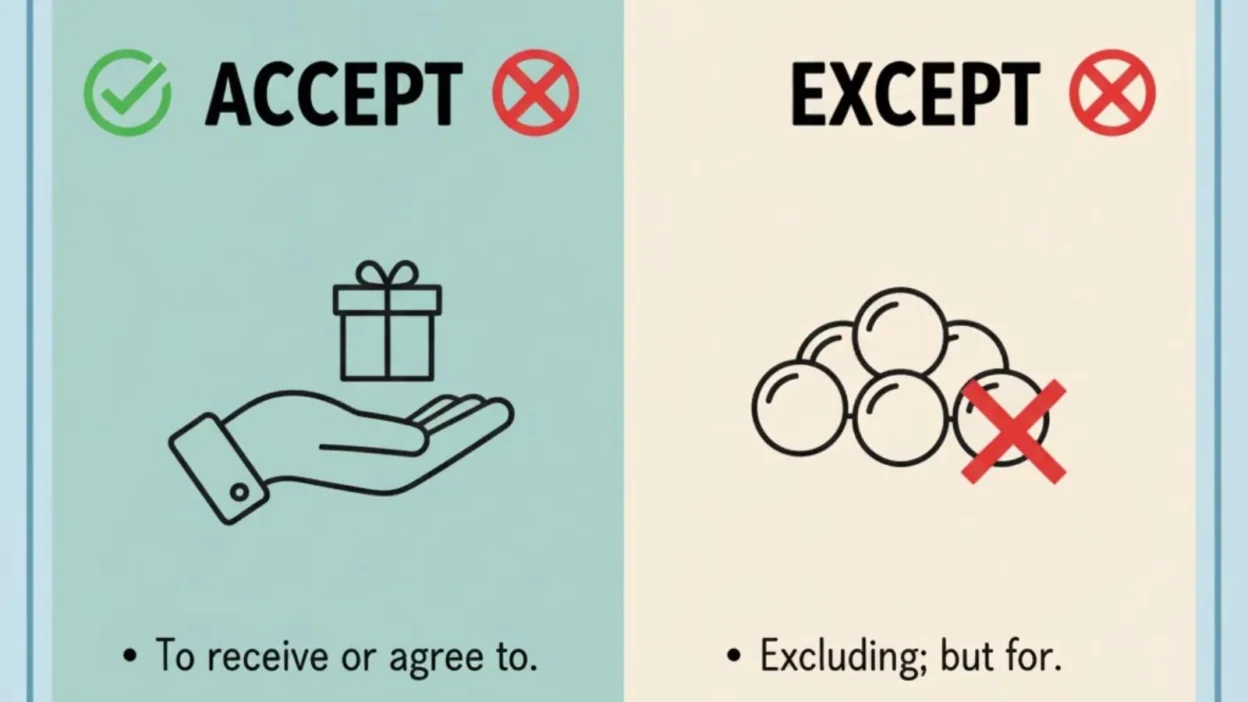
✅ Accept = to receive or agree to something.
🚫 Except = to exclude something or someone.
Examples:
- ✅ I accept your apology.
- 🚫 Everyone came to the party except John.
👉 Trick to remember:
Think “Accept = Agree / Acquire”
“Except = Exclude”
📚 The Origin of “Accept” or “Except”
Both words come from Latin roots! 🇮🇹
- Accept → from Latin accipere (“to take or receive”).
- Except → from Latin excipere (“to take out”).
💡 The “ac-” prefix means “toward,” while “ex-” means “out.”
That’s why accept means “to take in,” and except means “to leave out.” ✨
These small prefix differences create totally opposite meanings — one includes, the other excludes! 🚪➡️⬅️
🇬🇧🇺🇸 British English vs American English Spelling
Luckily, accept and except are spelled the same in both British and American English.
However, usage might slightly differ based on context or formality.
| Feature | 🇬🇧 British English | 🇺🇸 American English |
|---|---|---|
| Spelling | accept / except | accept / except |
| Usage Example | “She didn’t accept the offer.” | “He couldn’t accept the deal.” |
| Formal Context | Common in academic and business writing | Common in casual and business writing |
| Idioms | “Accept responsibility” | “Accept blame” |
👉 So, no matter where you write, the spelling won’t change — just the tone or usage might!
🎯 Which Spelling Should You Use?
✅ If you mean to agree, receive, or approve, use ACCEPT.
🚫 If you mean to exclude, use EXCEPT.
Audience-based guide:
| Audience | Recommended Word | Example |
|---|---|---|
| 🇺🇸 US Readers | accept / except | “I accept your offer.” |
| 🇬🇧 UK & Commonwealth | accept / except | “Everyone was there except Tom.” |
| 🌍 Global Use | accept / except | Both are universally understood. |
💡 Tip: Always recheck your sentence’s meaning — inclusion vs exclusion — before hitting “send”! 📧
⚠️ Common Mistakes with “Accept” or “Except”
❌ “I will except the gift.” → 🚫 Wrong!
✅ “I will accept the gift.” → 🎁 Correct!
❌ “Everyone accept John was late.” → 🚫 Wrong!
✅ “Everyone except John was late.” → ⏰ Correct!
Other Mistakes to Avoid:
- Mixing up meanings in formal letters.
- Using “accept” when you actually mean “apart from.”
- Forgetting that “except” often follows “everyone” or “nobody.”
💬 Tip: Try reading your sentence aloud — if it sounds like “agree,” it’s accept; if it sounds like “exclude,” it’s except. 👂✅
✍️ Accept or Except in Everyday Examples
📧 Emails:
- “Please accept my apology for the delay.”
- “Everyone will attend the meeting except Jake.”
📰 News:
- “The team accepted the new policy.”
- “All stores are open except on holidays.”
💬 Social Media:
- “I accept the challenge! 💪”
- “All my friends joined, except one 😅.”
📄 Formal Writing:
- “We accept your application.”
- “The rules apply to all except minors.”
🌍 Accept or Except – Google Trends & Usage Data
📊 According to Google Trends:
- “Accept” is searched 3x more often than “except.”
- Top countries searching for “accept vs except” include 🇺🇸 USA, 🇮🇳 India, 🇬🇧 UK, 🇨🇦 Canada, and 🇦🇺 Australia.
- Peak searches occur during academic seasons and exam periods.
| Country | Most Searched | Common Context |
|---|---|---|
| 🇺🇸 USA | accept | Job offers, apologies |
| 🇮🇳 India | except | Grammar questions |
| 🇬🇧 UK | accept | Business communication |
| 🇨🇦 Canada | except | Writing skills |
| 🇦🇺 Australia | accept | Academic writing |
📈 So globally, both are popular — but “accept” wins the crown 👑!
🙋♀️ FAQs About “Accept or Except”
1. What’s the main difference between “accept” and “except”?
👉 “Accept” means to agree or receive. “Except” means to exclude.
2. Can I use “except” at the start of a sentence?
✅ Yes! Example: “Except for a few errors, your essay was perfect.”
3. How do I remember the difference?
💡 Think: Accept = Add in, Except = Exclude.
4. Are both words verbs?
✅ “Accept” is a verb. “Except” can be a preposition or conjunction.
5. Is “acceptance” related to “accept”?
Yes! “Acceptance” is the noun form, meaning agreement or approval.
6. Is “exception” related to “except”?
✅ Yes! “Exception” means something that’s excluded or different.
7. Can both appear in one sentence?
Yes! Example: “I will accept all suggestions except this one.”
🏁 Conclusion
So, next time you hesitate over “accept” or “except,” remember this simple rule:
👉 Accept = to receive or agree.
👉 Except = to exclude or leave out.
These two tiny words carry big differences — one includes, the other excludes! 🌍 Whether you’re writing a business email, essay, or message, choosing correctly shows attention to detail and professionalism.
✨ Quick memory tip:
Accept = Add in
Except = Exclude out
Master this pair, and you’ll never make the mix-up again! 💪✍️
Discover More Articles
- ✅ Ensure or Insure What’s the Difference & Which Should You Use? 2026
- Passed or Past ✅ Quick Guide to Using Them Correctly 2026
- 🌟 Lay or Lie What’s the Difference? (A Simple Grammar Guide) 2026
- 🌟 Everyday or Every day What’s the Real Difference? 2026