When it comes to English spelling, few words spark more confusion than “alright or all right”.
🤷♂️ People often wonder: is one version wrong? Can they be used interchangeably?
In emails, essays, or casual chats, making the wrong choice might make your writing look less polished.
The confusion arises because “alright” feels modern and casual, while “all right” is traditional and widely accepted.
This article breaks it down, helping you understand when to use each form, avoid mistakes, and write with confidence.
Whether you’re a student, professional, or social media user, this guide will clarify the difference with examples, history, and usage tips.
Let’s make English spelling simple! ✨📚
Alright or All right – Quick Answer ✅
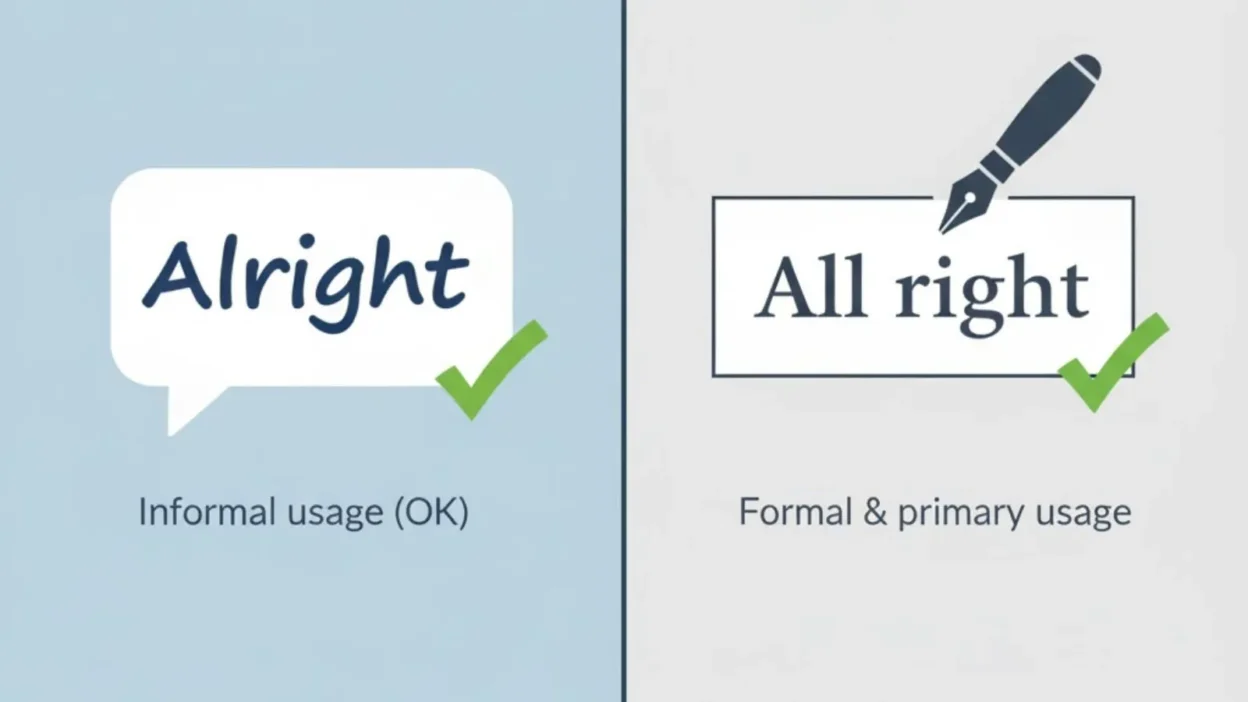
- All right ✅ → Standard, formal, and correct in professional writing.
- Example: “Are you all right after the trip?”
- Example: “Are you all right after the trip?”
- Alright ✨ → Informal, casual, often used in text messages, lyrics, or social media.
- Example: “I’m feeling alright today!”
- Example: “I’m feeling alright today!”
💡 Tip: If in doubt, stick to all right for formal contexts.
Alright vs All right ⚖️
Many people wonder: “Should I write alright or all right?” 🤔 The answer depends on context, formality, and audience.
- All right ✅ → Traditional, formal, and widely accepted in professional writing.
- Example: “Is everything all right with the report?”
- Alright ✨ → Informal, casual, common in text messages, social media, or creative writing.
- Example: “Don’t worry, I’m feeling alright!”
Quick Comparison Table 📝
| Form | Correctness | Usage Context |
|---|---|---|
| All right | Formal ✅ | Essays, emails, news, professional writing |
| Alright | Informal ✨ | Texts, social media, casual conversations |
💡 Tip: When writing for a professional or global audience, always prefer all right. Use alright only in casual, friendly contexts.
The Origin of Alright or All right 📜
The phrase “all right” dates back to the 15th century, literally meaning “completely correct” or “entirely satisfactory.” ✅ Over time, writers began merging it into “alright”, mainly in informal writing.
- All right → Traditional English, widely used in literature and professional writing.
- Alright → Modern spelling variant, popularized in the 19th and 20th centuries for casual texts.
📚 Interesting fact: Some style guides, including Oxford and Chicago Manual, still prefer all right in formal writing.
British English vs American English Spelling 🇬🇧🇺🇸
The difference isn’t just style—it’s regional preference:
| Form | British English | American English | Notes |
| All right | ✅ Standard | ✅ Standard | Safe for formal writing |
| Alright | ⚠️ Informal/accepted | ⚠️ Common in casual texts | Less formal, sometimes seen in creative writing |
UK: “Everything is all right with the plan.”- US: “Are you alright?” (casual)
💡 Rule of thumb: For official documents, essays, and professional writing, use all right.
Which Spelling Should You Use? 📝
- Formal writing: All right ✅
- Emails & social media: Alright or All right ✨
- Global audiences: Prefer all right to avoid confusion
Remember, “alright” is safe in informal contexts but may be marked wrong in academic or professional settings.
Common Mistakes with Alright or All right ❌
- Using alright in formal essays → ❌
- Wrong: “It is alright to skip the meeting.”
- Correct: “It is all right to skip the meeting.” ✅
- Wrong: “It is alright to skip the meeting.”
- Confusing all right with all-right → ❌
- All-right is rarely correct unless hyphenated for style.
- All-right is rarely correct unless hyphenated for style.
- Overusing alright in professional emails → ❌
- Stick to all right to maintain professionalism.
- Stick to all right to maintain professionalism.
Alright or All right in Everyday Examples 💬
- Emails: “I hope you’re all right after the meeting.”
- News: “The patient is reported to be all right.”
- Social Media: “Feeling alright today! 😎”
- Creative writing: “Everything will be alright in the end.”
Alright or All right – Google Trends & Usage Data 📊
- Searches for “alright or all right” spike during academic seasons, when students check grammar.
- US & UK usage differs slightly:
- US: alright used more casually
- UK: all right preferred in formal writing
- US: alright used more casually
- Overall, all right dominates professional and formal contexts worldwide.
Keyword Variations Comparison Table 🔍
| Variation | Correctness | Context |
| Alright | Informal | Casual writing, social media, texts |
| All right | Formal ✅ | Academic papers, professional documents, news |
| All-right | Rare | Mostly stylistic, rarely used |
FAQs ❓
- Is “alright” wrong?
- Not wrong in casual writing, but avoid in formal contexts.
- Not wrong in casual writing, but avoid in formal contexts.
- Can I use “alright” in emails?
- Only in informal or friendly emails; use all right in professional emails.
- Only in informal or friendly emails; use all right in professional emails.
- Which is better for school essays?
- All right is always the safer choice.
- All right is always the safer choice.
- Is “all right” one word?
- No, it’s two words in formal writing.
- No, it’s two words in formal writing.
- Why do people write “alright”?
- It’s a modern, simplified spelling for casual use.
- It’s a modern, simplified spelling for casual use.
- Do dictionaries accept “alright”?
- Most do, but some academic sources still prefer all right.
- Most do, but some academic sources still prefer all right.
- Does pronunciation change?
- No, both are pronounced the same: /ɔːlˈraɪt/.
- No, both are pronounced the same: /ɔːlˈraɪt/.
Conclusion 🎯
To sum up, “all right” is the traditional, formal spelling used in academic, professional, and news writing. ✅ “Alright” has become a casual, modern alternative suited for texts, social media, and informal writing. Knowing the difference helps you avoid common mistakes, write confidently, and communicate clearly.
💡 Rule of thumb: When in doubt, stick with all right. It’s universally correct, safe, and professional. Use alright only in casual, friendly contexts where informality is acceptable. By understanding their history, rules, and usage patterns, you can choose the right form for any situation. ✨
Discover More Articles
- Everytime or Every time Which One is Correct? 🤔 2026
- ✅ Anymore or Any more What’s the Correct Spelling? 2026
- 101 + Email or E-mail Which One is Correct? 📧 2026
- 💡 Noone or No One Which Is Correct? The Definitive Grammar Guide (With Examples) 2026