Many people search for “although or though” because these two small words often cause big confusion.
They look similar, sound similar, and in many cases, they can even replace each other.
Yet, choosing the right one can change the tone, formality, and clarity of your sentence. ⭐
If you’ve ever paused while writing an email, social media caption, or academic paper and wondered, “Should I write although… or though?” you’re not alone.
These words come from old English roots, and over time their usage has shifted, split, and adapted across British and American English. 🌍✍️
This article gives you a quick, clear, and simple explanation, plus real examples, a comparison table, Google Trends insights, and expert guidance on which word to choose.
By the end, you’ll know exactly when and how to use although and though with confidence. 💡🔥
Although or Though Quick Answer ⚡📘
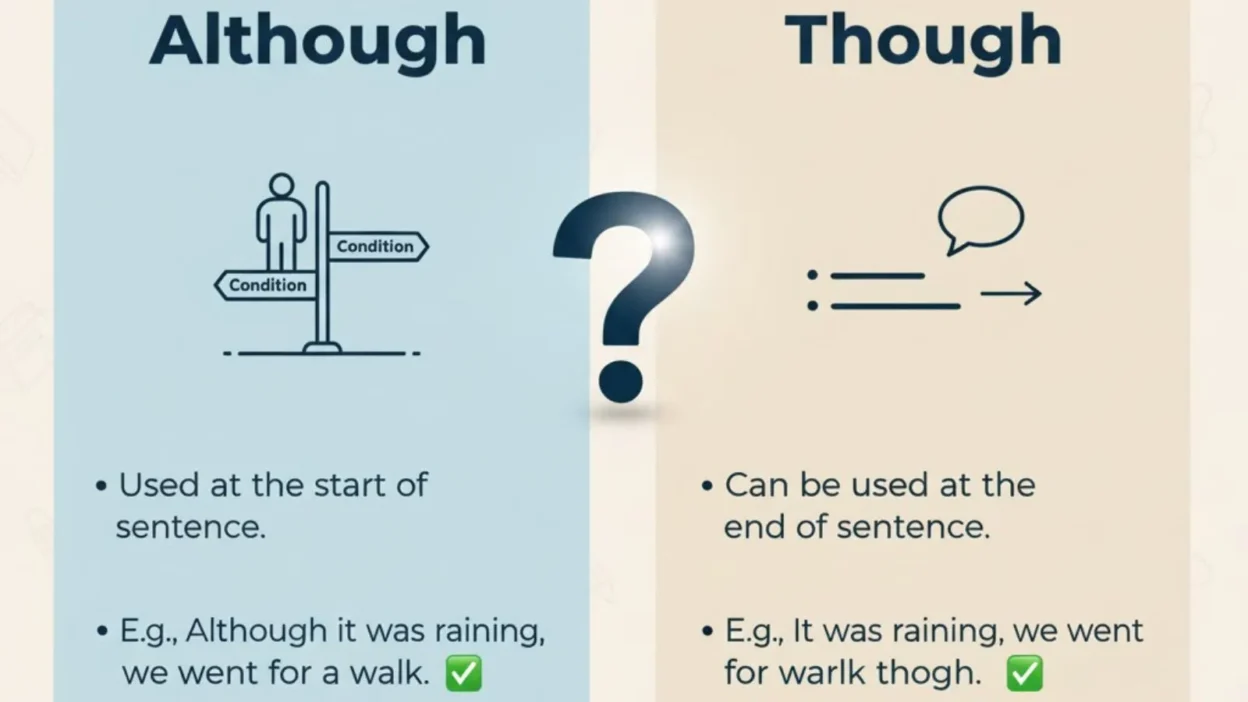
Both words mean the same: “in spite of” or “despite that.”
But their usage and tone differ.
✅ Use “although”
- More formal
- Common in writing
- Often used at the beginning of sentences
Example:
- Although it was raining, we went outside.
✅ Use “though”
- Less formal
- Common in speech
- Often used at the end of a sentence
Example:
- We went outside. It was raining, though.
The Origin of “Although” and “Though” 📜🌱
Both words come from Old English.
- Though → from “þēah,” meaning nevertheless or even if.
- Although → formed later combining “all” + “though,” meaning even though completely.
Over time, “although” became more formal, while “though” became shorter and more flexible.
This history explains why we often switch between them depending on tone or emphasis.
British English vs American English Spelling 🇬🇧🇺🇸
The good news: Both spellings are the same in the UK and US.
However, usage frequency differs:
- American English prefers though more often in speech.
- British English uses although more frequently in formal writing.
Comparison Table 🇬🇧 vs 🇺🇸
| Feature | British English | American English |
|---|---|---|
| Formal Writing | although | although |
| Casual Speech | though | though (very common) |
| Sentence End | though (common) | though (very common) |
| Mixed Tone | although / though | though |
Which Spelling Should You Use? 🎯
✔️ If writing for a US audience:
Use though for casual tone.
Use although for essays or formal emails.
✔️ If writing for UK/Commonwealth:
Use although more often in formal writing.
✔️ If writing for global readers:
Both are correct—but although feels clearer and safer in professional writing.
Common Mistakes with “Although or Though” ⚠️✏️
❌ Mistake 1: Using “although” with “but”
Wrong: Although it rained, but we played.
✔️ Correct: Although it rained, we played.
❌ Mistake 2: Using “though” too formally
Wrong: Though the contract is approved… (Sounds informal)
✔️ Correct: Although the contract is approved…
❌ Mistake 3: Mixing both in one sentence
Wrong: Although it was late, though we stayed.
✔️ Correct: Use only one.
“Although or Though” in Everyday Examples 📱📰✉️
- Although the meeting is delayed, we will continue with the plan.
News Writing
- Although the vote was close, the bill passed.
Formal Writing
- Although research supports the claim, more study is needed.
Casual Speech
- I liked the movie. It was long, though.
Although or Though – Google Trends & Usage Data 📊🌍
Google Trends shows:
- “Though” is more popular in the US, especially in informal contexts.
- “Although” trends higher in the UK, especially for academic or official writing.
- Globally, both terms are searched often because English learners want clarity on tone and formality.
People search this keyword most in:
- UK
- US
- India
- Pakistan
- Philippines
Reason: It’s a common grammar confusion among English learners worldwide.
Keyword Comparison Table 📝
| Keyword Variation | Meaning | Usage |
|---|---|---|
| although | formal contrast | writing |
| though | informal contrast | speech + writing |
| even though | stronger contrast | emphasis |
| though (sentence end) | soft contrast | conversation |
| although vs though | comparison | grammar learning |
FAQs ❓🌟
1. Are “although” and “though” the same?
Yes, they mean the same but differ in tone and formality.
2. Is “though” informal?
Yes, mostly. It’s very common in speaking.
3. Can I use both in one sentence?
No. Use only one for contrast.
4. Can “though” come at the end of a sentence?
Yes! It’s common: I liked it, though.
5. Is “although” better for essays?
Yes. It sounds more formal and clear.
6. Can I start a sentence with “though”?
Yes, but it creates a very casual tone.
7. Are there spelling differences in UK and US English?
No—both spellings are the same.
Conclusion 🌟📘
The words “although” and “though” share the same meaning but serve different roles depending on tone, style, and formality. Understanding when to use each makes your writing smoother and more natural. ✨
“Although” works best in formal or professional writing, where clarity matters most. “Though” fits well in speech, casual messages, and relaxed writing. Both are grammatically correct, but the choice depends on your audience, the setting, and how strong you want the contrast to sound.
Knowing the difference helps you avoid common mistakes, write cleaner sentences, and communicate with confidence—whether you’re drafting an email, posting online, writing an essay, or speaking in everyday conversation. With practice, you’ll instinctively choose the right one, and your English will sound more natural and fluent. ✔️🔥
Use this guide whenever you feel unsure, and you’ll never mix up “although or though” again.
Discover More Articles
- Worshiping or Worshipping Which Spelling Is Right? 2026🙏
- 🌟 Whether or If What’s the Difference? (Full Guide + Examples) 🌟2026
- Despite or In Spite Of What’s the Difference? (Full Guide) ✨📚 2026
- 🌟Because of or Due to What’s the Difference? (Complete Guide) ✨📘 2026