Have you ever paused mid-sentence wondering whether to write altogether or all together? 🤔
You’re not alone! Many English learners — and even native speakers — get confused by this tricky pair.
Both phrases sound identical but carry different meanings and grammar functions.
This tiny space between “all” and “together” can completely change the meaning of your sentence!
People often search for “Altogether or All together” when writing emails, essays, or social media captions — just to make sure they’re grammatically correct. 📚
This article will make everything crystal clear!
We’ll explore their meanings, examples, origins, and even how spelling rules differ between British 🇬🇧 and American English 🇺🇸.
You’ll also find practical writing tips, usage data, and an FAQ section to clear up all doubts.
So, let’s dive in and finally settle the “Altogether vs All together” confusion once and for all! 💡
✅ Altogether or All together – Quick Answer
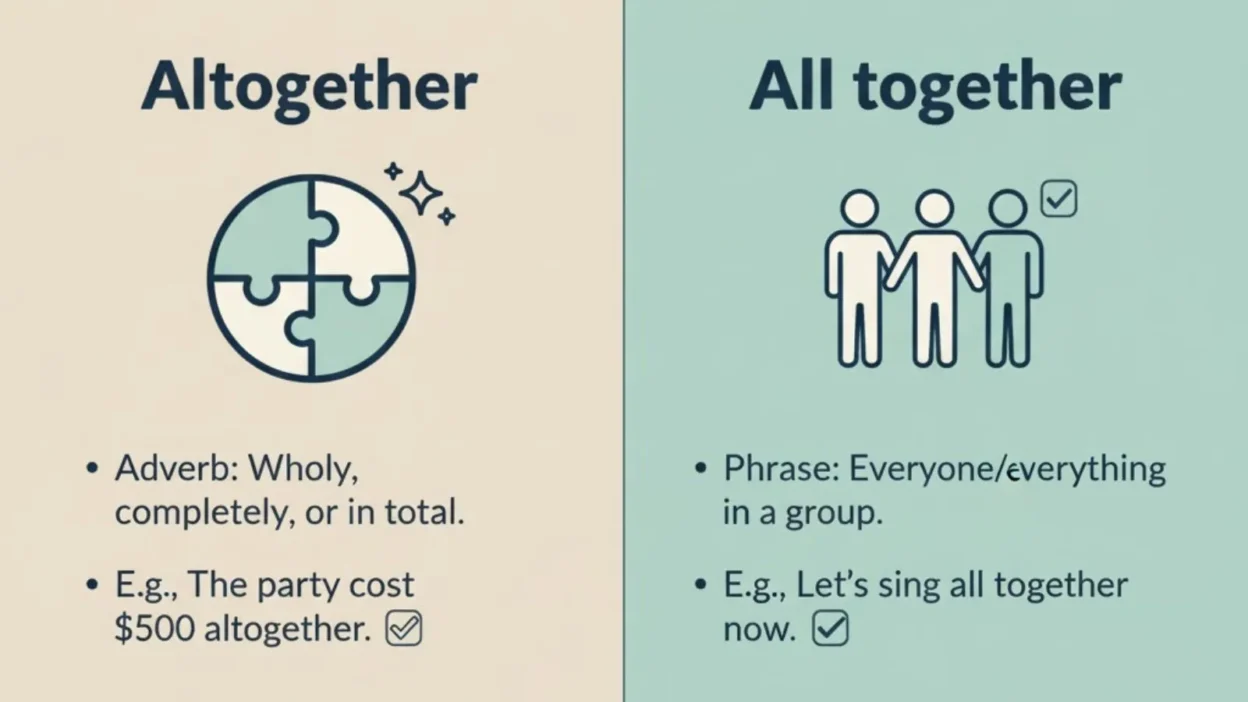
👉 Altogether (one word) means completely, entirely, or in total.
👉 All together (two words) means everyone or everything in one place or at one time.
🧩 Examples:
- ✅ The plan was altogether too complicated. (completely)
- ✅ We sang the song all together at the end. (everyone together)
💬 Quick Tip:
If you can replace the word with “completely”, use altogether.
If you mean “everyone/everything in one group”, use all together.
🕰️ The Origin of “Altogether or All together”
Both forms come from Middle English, where “all” and “together” were often written separately. Over time, “altogether” evolved as an adverb meaning entirely or completely, while “all together” remained a phrase used for groups or collective actions.
📜 The distinction became clearer during the 17th–18th centuries as English spelling became standardized. The single-word form developed its own meaning, which no longer fit the “group sense” of the two-word phrase.
So, this confusion exists because the two phrases share the same roots but diverged in meaning as English evolved. 🌿
🇬🇧🇺🇸 British English vs American English Spelling
Good news — both British and American English use the same spellings for these words! 🙌
However, there can be usage preferences. Americans tend to use “altogether” slightly more often in informal writing, while British speakers use “all together” more frequently in social contexts.
📊 Comparison Table:
| Context | British English 🇬🇧 | American English 🇺🇸 | Meaning |
|---|---|---|---|
| “It was altogether wrong.” | ✅ Common | ✅ Common | Completely |
| “They arrived all together.” | ✅ Common | ✅ Common | As a group |
| “He quit altogether.” | ✅ | ✅ | Entirely |
| “Let’s go all together.” | ✅ | ✅ | Everyone together |
🧠 Which Spelling Should You Use?
It depends on what you want to say! ✍️
- 🌍 For global English: both are accepted, just use the correct meaning.
- 🇺🇸 American writers: use altogether for totality, all together for group actions.
- 🇬🇧 British/Commonwealth writers: same rule applies — both are fine depending on context.
💡 Pro Tip: Even in academic or professional writing, the key is meaning — not location. Always check your sentence: does it mean completely or collectively?
⚠️ Common Mistakes with “Altogether or All together”
🚫 Incorrect: “We went altogether to the park.”
✅ Correct: “We went all together to the park.”
🚫 Incorrect: “That’s all together wrong.”
✅ Correct: “That’s altogether wrong.”
Other frequent mix-ups include:
- Using “altogether” when describing people. ❌
- Using “all together” when describing totality or sum. ❌
Remember:
👉 Altogether = completely
👉 All together = as a group
💬 “Altogether or All together” in Everyday Examples
📧 Email:
“We are all together in support of your decision.”
📰 News:
“The project was altogether too expensive to continue.”
📱 Social Media:
“Friends who laugh all together, stay together! 😄”
📚 Formal Writing:
“It is altogether appropriate to thank the committee.”
🎤 In short — altogether fits emotion or summary; all together fits unity and people.
📈 “Altogether or All together” – Google Trends & Usage Data
According to Google Trends, searches for “Altogether or All together” peak in English-learning countries like India, Nigeria, and the Philippines 🌍.
| Country | Most Searched Form | Context |
|---|---|---|
| United States 🇺🇸 | Altogether | Academic & essays |
| United Kingdom 🇬🇧 | All together | Group expressions |
| India 🇮🇳 | Both | Grammar learning |
| Canada 🇨🇦 | Altogether | Business writing |
| Australia 🇦🇺 | All together | Social or family context |
📊 Fun Fact: “Altogether” is used about 60% more frequently in online writing than “all together.”
❓ FAQs about “Altogether or All together”
1. Is it correct to say “We are altogether now”?
❌ No. Use “We are all together now.”
2. Can “altogether” start a sentence?
✅ Yes! Example: “Altogether, it was a great success.”
3. Which is more formal — altogether or all together?
➡ “Altogether” is slightly more formal.
4. Do both work in British and American English?
✅ Yes, meanings are identical worldwide.
5. What’s the difference in pronunciation?
None — both sound the same! 😄
6. Can I use “altogether” in academic writing?
✅ Absolutely. It’s often used for summaries or conclusions.
7. How to remember the difference easily?
💡 If you mean everyone, use two words (all together).
If you mean completely, use one word (altogether).
🏁 Conclusion
The confusion between altogether and all together is completely understandable — after all, they look and sound almost the same! 😅 But now you know the simple rule:
- 🟩 Altogether = completely / entirely / in total
- 🟦 All together = everyone / everything in one place or time
These two forms have different grammar roles and meanings, so your choice depends on what you want to express. Whether you’re writing an academic paper, an email, or a caption, choosing the right form adds clarity and professionalism. ✍️
So next time you type one of these, take a quick pause and ask yourself — am I talking about totality or togetherness? That one second can make your writing ✨ shine ✨!
Discover More Articles
- ⭐ Principal or Principle What’s the Difference? (Easy Guide + Examples) 2026
- ✨ Complement or Compliment What’s the Difference? ✨2026
- 🌍 Further or Farther What’s the Right Word to Use? 2026
- ✔️101+Who or Whom? The Complete Beginner Friendly Guide 2026