Have you ever paused mid-sentence wondering whether to write “anymore” or “any more”? 🤔 You’re not alone!
This tiny space between “any” and “more” confuses millions of English learners and even native speakers.
People often search for “Anymore or Any more” because both look right — yet they don’t always mean the same thing!
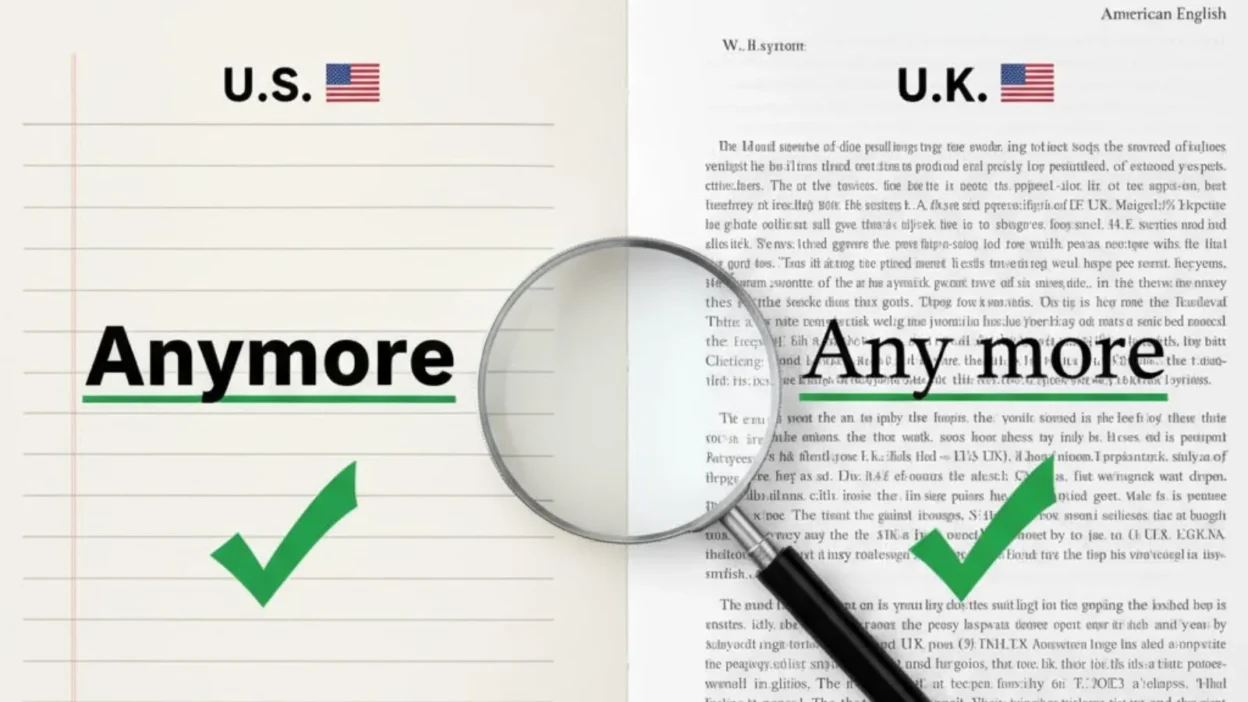
The difference depends on meaning, sentence use, and regional spelling (especially between British and American English 🇬🇧🇺🇸).
In this article, we’ll clear the confusion once and for all — with examples, origins, comparisons, and even a usage table 📊.
Whether you’re writing an email, an essay, or a social media post, you’ll know exactly when to use “anymore” and when to use “any more.”
Let’s dive in! 🚀
💡 Anymore or Any more – Quick Answer
👉 “Anymore” is usually used as an adverb in American English, meaning “any longer.”
👉 “Any more” is used to refer to quantity or amount.
✅ Examples:
- I don’t live there anymore. (❌ not any longer)
- I don’t want any more cake. (quantity)
So, both are correct — but they serve different purposes. Easy, right? 😄
📜 The Origin of “Anymore or Any more”
The phrase “any more” dates back to Old English, meaning “a greater quantity” or “further.” Over time, as English evolved, American writers began to blend the words into one: “anymore.”
👉 British English kept the traditional two-word form.
👉 American English adopted the combined version, similar to “anyone,” “somebody,” and “everyday.”
So, the difference mainly comes from language evolution and regional simplification over centuries 📖.
🇬🇧🇺🇸 British English vs American English Spelling
| Usage | British English 🇬🇧 | American English 🇺🇸 | Meaning |
| Negative statements | I don’t go there any more | I don’t go there anymore | No longer |
| Referring to quantity | I don’t need any more money | I don’t need any more money | Extra amount |
| Formal writing | Any more | Anymore (less formal) | Depends on tone |
| Everyday speech | Any more | Anymore | Depends on dialect |
👉 Tip: In American writing, “anymore” is common in negative sentences. In British writing, it’s almost always “any more.”
✍️ Which Spelling Should You Use?
It depends on your audience and tone:
🌎 Global readers: Use “any more” – universally accepted.
🇺🇸 American audience: “Anymore” fits naturally in informal contexts.
🇬🇧 British or Commonwealth: Stick with “any more.”
👉 In formal or academic writing, “any more” is always safe ✅.
Example:
- Formal: “We don’t have any more tickets available.”
- Casual: “We don’t sell them anymore.”
⚠️ Common Mistakes with Anymore or Any more
🚫 Wrong: I don’t want anymore of that noise.
✅ Right: I don’t want any more of that noise.
🚫 Wrong: We don’t go there any more often.
✅ Right: We don’t go there anymore.
🔹 Tip: If you’re talking about time, use “anymore.”
🔹 If you’re talking about amount or quantity, use “any more.”
⚠️ Common Mistakes with Anymore vs Any more
🚫 Wrong: I don’t want anymore of that noise.
✅ Right: I don’t want any more of that noise.
🚫 Wrong: I don’t eat sugar any more often.
✅ Right: I don’t eat sugar anymore.
🔹 Rule of Thumb:
Use “any more” when talking about amount (quantity).
Use “anymore” when talking about time (any longer).
💬 Anymore or Any more in Everyday Examples
🖊️ Emails:
- “We don’t offer that service anymore.”
- “Do you have any more information on the project?”
🗞️ News:
- “People don’t use paper maps anymore.”
- “There isn’t any more funding for the project.”
💻 Social Media:
- “I can’t deal with this drama anymore 😩.”
- “No, I don’t need any more coffee today ☕.”
🎓 Formal Writing:
- “The data shows there are no any more variations.” ❌
- “The data shows there are no more variations.” ✅
📊 Anymore or Any more – Google Trends & Usage Data
| Region | Most Common Form | Popular Context |
| United States 🇺🇸 | Anymore | Everyday speech, blogs, casual writing |
| United Kingdom 🇬🇧 | Any more | News, academic papers, official writing |
| Canada 🇨🇦 | Both used | Depends on context |
| Australia 🇦🇺 | Any more | Preferred in formal writing |
🌍 Google Trends Insight:
- “Anymore” ranks higher in North America.
- “Any more” dominates Europe, Asia, and Commonwealth nations.
❓ FAQs about “Anymore or Any more”
1. Is “anymore” one word or two?
Both are correct — “anymore” (American) and “any more” (British).
2. Can I use “anymore” in formal writing?
It’s better to use “any more” in formal or academic contexts.
3. What’s the difference in meaning?
“Anymore” = any longer (time).
“Any more” = additional (quantity).
4. Which one do British people use?
British English almost always prefers “any more.”
5. Are “anymore” and “no longer” the same?
Yes, “anymore” often replaces “no longer” in American English.
6. Can I use both in one sentence?
Yes! Example: “I don’t need any more excuses anymore.”
7. Why does this difference exist?
Because of language evolution — American English simplifies compound phrases.
🏁 Conclusion
So, the next time you pause while typing “anymore or any more”, remember this simple rule:
👉 Use “anymore” when referring to time (any longer).
👉 Use “any more” when referring to quantity or amount.
Both are grammatically correct — just choose the one that fits your audience and tone 🎯.
In short:
✅ American = “Anymore”
✅ British = “Any more”
Keep it clear, consistent, and context-based — and you’ll never make this mistake again! ✨
Discover More Articles
- Everytime or Every time Which One is Correct? 🤔 2026
- 💡 Noone or No One Which Is Correct? The Definitive Grammar Guide (With Examples) 2026
- 101 + Alright or All right Which One Is Correct? 🤔✍️ 2026
- 101 + Email or E-mail Which One is Correct? 📧 2026