If you’ve ever paused while writing and wondered, “Should I say anyway or anyways?” — you’re not alone.
This is a common grammar question asked by students, bloggers, professionals, and even native English speakers.
The confusion comes from how the word is used in real life. You’ll hear people say “anyways” in movies, on social media, and in casual speech.
But you’ll also see “anyway” used in books, articles, and formal writing. So which one is correct?
This article explains the true difference between anyway vs anyways, when to use each one, and why it matters.
We’ll look at grammar rules, examples, origin, and usage in both American and British English.
We’ll also check Google Trends data and answer common FAQs. By the end, you’ll never be confused again.
Anyway vs Anyways – Quick Answer
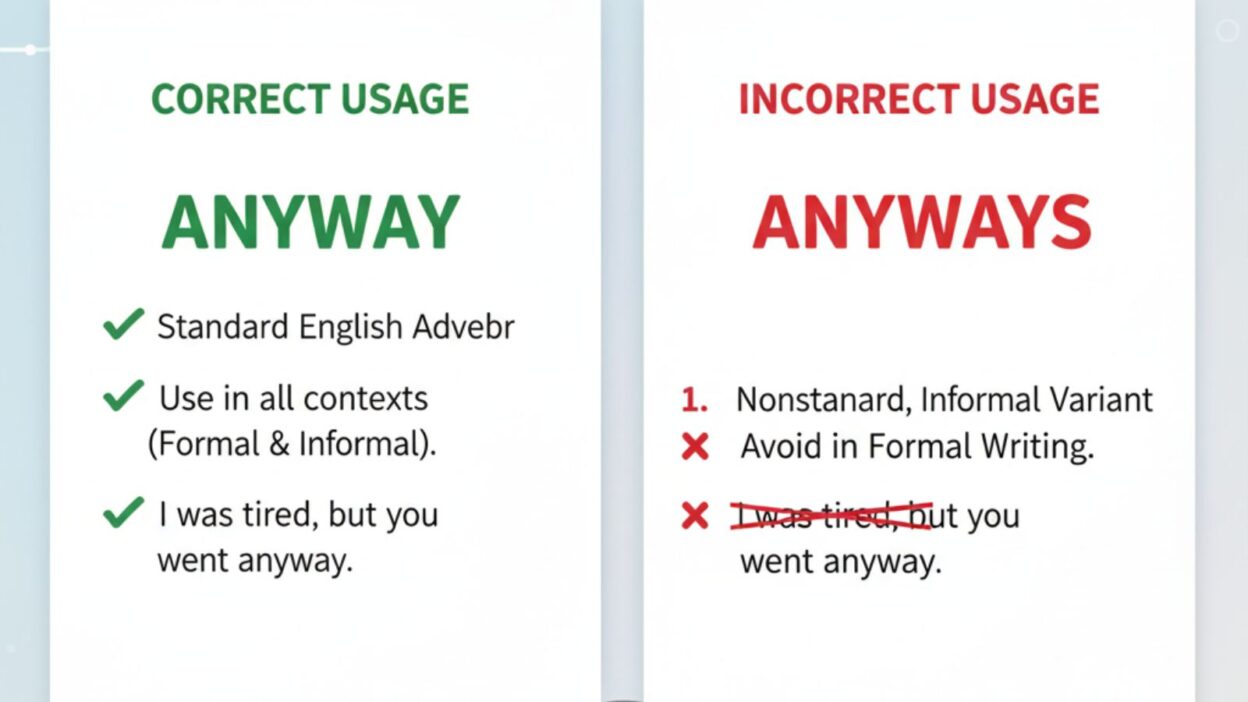
The correct and standard word in English is “anyway”. The word “anyways” is considered informal and often seen as incorrect in formal writing.
✅ Correct:
- Anyway, let’s get started.
- I didn’t like the movie, but I watched it anyway.
⚠️ Informal/Incorrect in formal writing:
- Anyways, let’s get started.
The Origin of Anyway vs Anyways
The word “anyway” comes from Old English and has been used since the 13th century. It is a combination of “any” + “way”, meaning “in any manner” or “regardless”.
“Anyways” came later. It started appearing in rural and regional dialects in North America around the 1800s. It was formed by adding the -s ending (like in “towards” or “backwards”), which was common in spoken English at that time. However, it never became accepted in formal grammar.
British English vs American English Spelling
Both British and American English accept “anyway” as correct.
However, “anyways” is more common in American informal speech.
| Feature | British English | American English |
| Formal writing | anyway ✅ | anyway ✅ |
| Spoken language | anyway ✅ | anyway ✅ / anyways (informal) |
| Academic use | anyway ✅ | anyway ✅ |
| Seen online/social media | rare | common |
Which Spelling Should You Use?
| Situation | Use |
| Academic writing | anyway |
| Business email or report | anyway |
| Essay or blog post | anyway |
| Text message or casual speech | anyways (optional, informal) |
| Professional content | anyway |
Tip: To look professional, always choose “anyway.”
Common Mistakes with Anyway vs Anyways
| Mistake | Correct Form |
| Anyways, I don’t care. | Anyway, I don’t care. |
| She didn’t like it, but she did it anyways. | She didn’t like it, but she did it anyway. |
| Anyways is correct in essays. | Wrong. Use anyway. |
Anyway vs Anyways in Everyday Examples
Emails (formal):
✅ Anyway, thank you for your time.
News/Articles:
✅ The team lost, but they played hard anyway.
Social Media (casual):
⚠️ Anyways, who cares 😂
Job Interview:
✅ Always use anyway.
Anyway vs Anyways – Google Trends & Usage Data
- “Anyway” is searched and used more worldwide.
- “Anyways” is growing in use in the US, Canada, and social media.
- Formal sources (news, education, business) avoid “anyways.”
Keyword Comparison Table
| Keyword Variation | Correctness | Usage |
| anyway | ✅ Correct | Formal + informal |
| anyways | ⚠️ Informal only | Casual speech |
| any way | ✅ Correct in different meaning (separate words) | Is there any way to help? |
| any-way | ❌ Incorrect | Never |
FAQs
1. Is “anyways” a real word?
Yes, but it’s informal and not accepted in formal writing.
2. Is “anyway” American or British?
Both. It’s standard in all English styles.
3. Is “anyways” rude?
No, but it sounds casual or unprofessional.
4. Can I use “anyway” at the start of a sentence?
Yes. Example: Anyway, let’s move on.
5. What’s the difference between “anyway” and “any way”?
“Any way” means “any method.” Example: Is there any way to fix this?
“Anyway” means “regardless” or “besides.”
6. Can I use “anyways” in emails?
Avoid it. Use “anyway”.
7. Why do people say “anyways” if it’s wrong?
Habit, slang, and regional speech patterns.
Conclusion
The choice between anyway vs anyways is simple. If you want to sound clear, correct, and professional, always use “anyway.” The form “anyways” is not wrong in casual speech, but it doesn’t belong in essays, business writing, or serious content. Understanding this difference helps you improve your English grammar and write with confidence.
Use “anyway” to:
- Show a change in topic
- Continue your point
- Add emphasis
So next time you write, remember: good grammar is a habit. Start with anyway.
Discover More Articles
- 🌞 Good Morning or Goodmorning Which Is Correct? 2026
- 101+Domain and Range Meaning, Rules & Simple Examples (2026)
- 101+Prefer or Perfer What Is the Correct Spelling? (2026)
- Hippy or Hippie Which Spelling Is Correct and When to Use Each? 2026