Many people search for “because of or due to” because these two phrases seem almost the same.
But small grammar rules make writers unsure which one is correct in formal writing.
You may face this confusion while writing an email, report, school assignment, or social media post.
A simple sentence like “The flight was delayed because of the weather” suddenly makes you think, “Should I use due to?” ✍️🤔
The good news? The difference is easy once you see how each phrase works. This guide explains everything in simple words.
No complex grammar. No long rules. Only clear examples and quick answers. 🚀
You will learn when to use each phrase, how the usage changed over time, and which spelling fits American, British, and global English.
You’ll also see real-world examples, common mistakes, tables for fast comparison, and Google Trends data summaries.
By the end, you will never mix up because of and due to again. Let’s make English simple and stress free. 💡😊
Because of or Due to – Quick Answer ⚡📌
Short Explanation
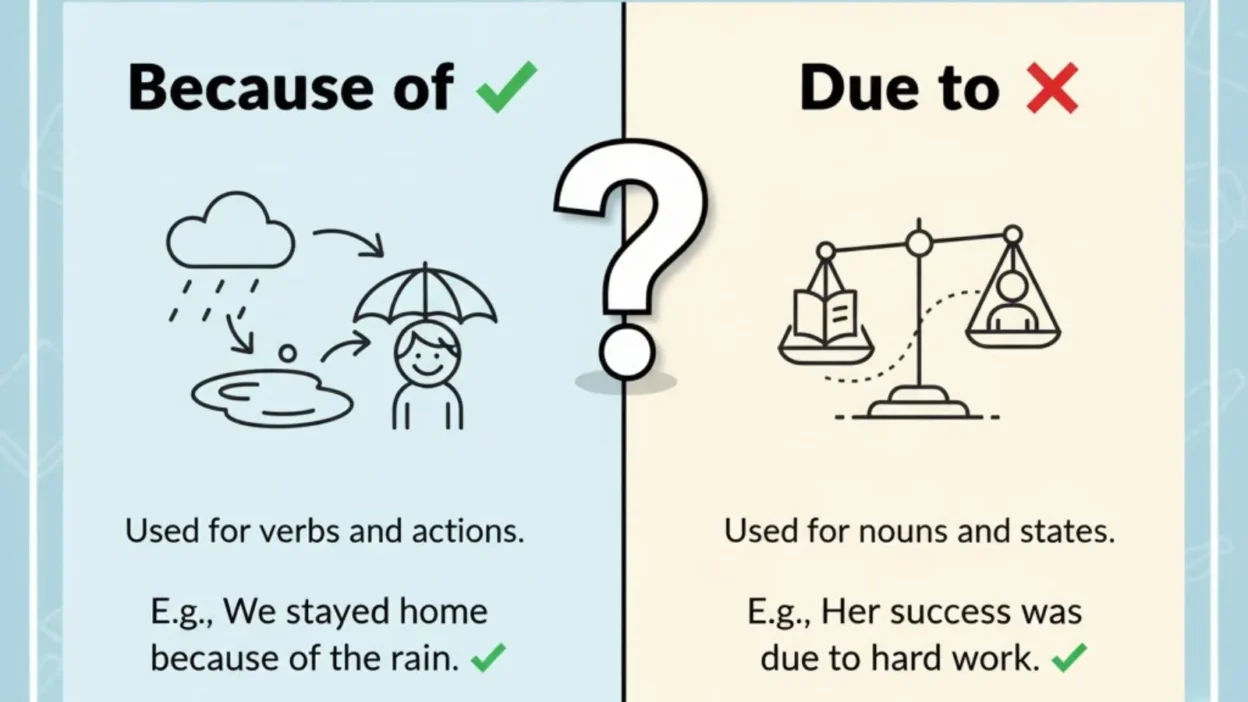
- Because of → Used before a reason (noun).
- Due to → Used after a linking verb (is, was, were) to describe something.
Easy Examples
✔️ Because of
- The game was canceled because of rain.
- She stayed home because of illness.
✔️ Due to
- The delay was due to traffic.
- Her success is due to hard work.
👉 Quick Tip: If you can replace the phrase with “caused by,” use due to. Otherwise, use because of.
The Origin of “Because of or Due to” 🕰️📚
Both phrases come from Old and Middle English.
Because of
- Comes from “bi cause of” (Middle English).
- It literally meant “by the cause of.”
Due to
- Comes from the word “due,” meaning “owed” or “deserved.”
- First used in accounting and legal texts.
- Over time, writers began using it to explain reasons.
Why the Confusion?
Many style guides (old ones!) said due to should only follow a form of the verb to be (is, was, were). Modern English is more flexible, but formal writing still prefers this rule.
That’s why people still search: Which one is correct? 🤷♂️📘
British English vs American English Spelling 🇬🇧🇺🇸✍️
Both phrases are spelled the same in the US and UK.
The difference is usage preference:
American English (US)
- Looser rules
- Accepts because of and due to in most places
British English (UK)
- More traditional
- Prefers due to only after linking verbs
- Prefers because of for general reasons
Comparison Table 📊
| Feature | Because of | Due to |
|---|---|---|
| Typical Use | Shows reason | Describes a condition |
| Form | Flexible | More formal |
| US Usage | Very common | Common |
| UK Usage | Very common | Used more strictly |
| Follows Linking Verb? | ❌ No | ✔️ Yes |
Which Spelling Should You Use? 👍🌍
If your audience is in the US 🇺🇸
✔️ Use either phrase.
✔️ Both sound natural.
✔️ Most readers will not care which you choose.
If your audience is in the UK or Commonwealth 🇬🇧🇨🇦🇦🇺
✔️ Follow the traditional rule:
- Use because of → general reasons
- Use due to → after is/was/were
If writing for a global audience 🌍
✔️ Choose because of — the safest and clearest option.
✔️ Works in business, education, and everyday writing.
Common Mistakes With “Because of or Due to” ⚠️✏️
❌ Wrong
“He missed the meeting due to he woke up late.”
✔️ Correct
“He missed the meeting because of waking up late.”
More Common Errors
| Mistake | Correction |
|---|---|
| Using due to before an action | Replace with because of |
| Adding a full clause after due to | Use a noun phrase instead |
| Mixing both phrases in one sentence | Use only one for clarity |
Because of or Due to in Everyday Examples 💬📰📧
Emails
- We canceled the event because of heavy rain.
- The delay was due to a power issue.
News
- Flights were disrupted because of fog.
- The loss was due to poor planning.
Social Media
- Stayed home because of the storm! 🌧️
- My success is due to your support ❤️.
Formal Writing
- The failure was due to system errors.
- Production slowed because of a shortage of materials.
Because of or Due to Google Trends & Usage Data 📈🌎
Google Trends shows:
- “Because of” is more popular worldwide.
- “Due to” is highly searched in academic and business contexts.
- Countries with highest searches:
- US 🇺🇸
- UK 🇬🇧
- India 🇮🇳
- Philippines 🇵🇭
- Pakistan 🇵🇰
People often search these keywords together because they want:
✔️ Fast grammar rules
✔️ Correct usage for emails
✔️ Clear difference
✔️ Simple examples
Comparison Table Keyword Variations 🧾📊
| Phrase | Meaning | Formality | Best Use |
|---|---|---|---|
| Because of | Shows reason | Neutral | Everyday writing |
| Due to | Describes condition | More formal | Business + academic |
| Owing to | Similar to due to | Formal | Reports |
| As a result of | Cause/effect | Formal | Research writing |
FAQs ❓💡
1. Is “due to” formal?
Yes. It sounds more formal than “because of.”
2. Can I start a sentence with “due to”?
Yes, in modern English. But formal writers avoid it.
3. Which is more common?
“Because of” is more common worldwide.
4. Is “due to” the same as “because of”?
Not always. Due to describes a condition; because of gives a reason.
5. How do I choose the right phrase?
Use because of when unsure — it is the safest.
6. Do grammar exams test this rule?
Yes. Many English tests still use the traditional rule.
7. Does “due to” need a noun?
Yes. It should follow linking verbs like is/was.
Conclusion 🌈📘
Choosing between because of and due to does not need to be difficult. The phrases are used for similar reasons, but each has a clear place in English. Because of works almost everywhere and is the best choice when you want simple, clear writing. Due to works best after a linking verb, especially in formal writing, reports, or academic papers. ✍️✨
If your audience is global, because of is the safest phrase. If you write for the UK, follow the traditional rule. If you write for the US, both options sound natural. Knowing this difference helps you write clearly and professionally in emails, essays, news posts, and business documents.
Now you can use these phrases with confidence — no more guessing, no more grammar stress. English becomes simple when you know the rule, see the examples, and practice in real sentences. Keep this guide for quick reference, and your writing will always stay clean, correct, and easy to understand. 🌟📚
Discover More Articles
- Worshiping or Worshipping Which Spelling Is Right? 2026🙏
- 🌟 Whether or If What’s the Difference? (Full Guide + Examples) 🌟2026
- Despite or In Spite Of What’s the Difference? (Full Guide) ✨📚 2026
- ✨101+Although or Though Which One Should You Use? 2026✨