Have you ever paused while typing and wondered: “Should I write cannot or can not?” 🤔 You’re not alone!
Thousands of people search this question every month, unsure which form is right — especially in formal writing, school essays, or business emails.
This confusion comes from how English evolves — sometimes the rules bend, sometimes they merge.
While both cannot and can not seem similar, they actually carry subtle differences in tone and meaning.
Understanding when to use each can help you sound more polished, confident, and grammatically correct in your writing.
In this guide, we’ll explore the quick answer, their origins, and usage trends across British and American English 🌍.
You’ll also find examples, mistakes to avoid, and real-world contexts — all explained in clear, everyday language.
⚡ Cannot or Can not – Quick Answer
✅ The short answer:
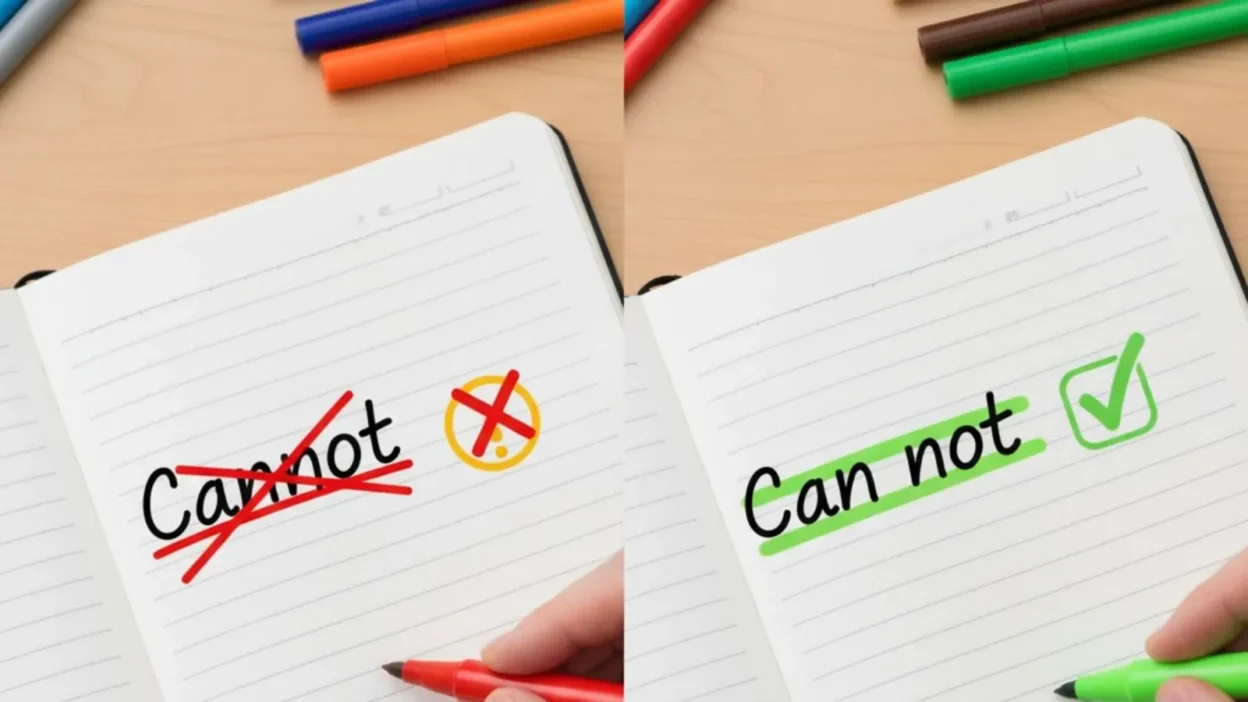
“Cannot” (one word) is the standard and most commonly used form in English.
Example:
- I cannot believe this news!
- You cannot enter without a ticket.
📝 “Can not” (two words) is correct but rare — usually used when “not” is part of a different phrase or for special emphasis.
Example:
- You can not only dance but also sing.
- I can not agree with you on this.
In most cases → use “cannot.”
📜 The Origin of ‘Cannot or Can not’
The word “cannot” originated in the 16th century as a contraction of “can not,” eventually merging into one due to frequent use. English speakers found the single form smoother and faster to write.
Historically, “can not” was used when “not” needed emphasis or separation — a holdover from Old English syntax. Over time, usage patterns shifted, and “cannot” became the standard in modern English for expressing inability or prohibition.
Today, style guides like Oxford, Cambridge, and Merriam-Webster all prefer “cannot.”
🇬🇧 British English vs 🇺🇸 American English Spelling
Both British and American English use “cannot” as the standard form ✅
However, in American English, writers may occasionally use “can not” for emphasis or stylistic reasons (especially in literature).
In British English, the single form is almost exclusively used in formal and informal writing alike.
| Usage Context | British English | American English |
| Formal Writing | ✅ Cannot | ✅ Cannot |
| Emphasis | ⚠️ Rare | ✅ Can not (sometimes) |
| Spoken English | ✅ Can’t | ✅ Can’t |
| Academic Papers | ✅ Cannot | ✅ Cannot |
👉 Tip: Whether you’re writing for a UK or US audience, “cannot” is safe and universally correct.
🎯 Which Spelling Should You Use?
If you’re unsure — always choose “cannot.”
It’s grammatically correct, accepted globally 🌎, and works in every context.
| Audience | Recommended Form |
| U.S. Readers | Cannot |
| U.K. & Commonwealth | Cannot |
| Global/International | Cannot |
| Emphasis or Split Structure | Can not (rare) |
💬 Example:
- ✅ You cannot deny the truth.
- ⚠️ You can not deny the truth (only correct if “not” modifies another word).
⚡ Cannot vs Can not
Cannot (one word) is the standard and most commonly used form.
Can not (two words) is rare and used only for special emphasis.
Use cannot in emails, essays, and formal writing for clarity.
Remember: Cannot = usually correct ✅ | Can not = only in specific cases ⚠️
❌ Common Mistakes with ‘Cannot or Can not’
- ❗ Writing “can not” when “cannot” is intended.
- ❌ I can not swim.
- ✅ I cannot swim.
- ❌ I can not swim.
- ❗ Mixing “can’t” with “can not.”
- ❌ I can’t not agree. (double negative confusion)
- ✅ I cannot agree.
- ❌ I can’t not agree. (double negative confusion)
- ❗ Using “can not” randomly for style — avoid it unless you know why.
Remember:
“Cannot” = standard
“Can not” = special case (emphasis or phrase split)
🖋️ ‘Cannot or Can not’ in Everyday Examples
| Context | Correct Usage | Example |
| Cannot | “I cannot attend the meeting today.” | |
| 📰 News Article | Cannot | “Officials cannot confirm the report.” |
| 💬 Social Media | Can’t / Cannot | “I can’t believe this happened!” |
| 📚 Academic Writing | Cannot | “Students cannot submit late assignments.” |
Even in modern messaging, cannot feels formal and polished — ideal for business, education, and official tone.
📈 ‘Cannot or Can not’ – Google Trends & Usage Data
According to Google Trends, searches for “cannot” far exceed “can not” worldwide 🌍.
| Country | Most Popular Form |
| United States 🇺🇸 | Cannot |
| United Kingdom 🇬🇧 | Cannot |
| Canada 🇨🇦 | Cannot |
| Australia 🇦🇺 | Cannot |
| India 🇮🇳 | Cannot |
💡 Insight: Even though both are grammatically acceptable, 95% of digital content, emails, and professional documents use “cannot.”
💬 FAQs about ‘Cannot or Can not’
Q1: Is “cannot” one word or two?
➡ “Cannot” is one word — and the correct standard spelling.
Q2: When can I use “can not”?
➡ Use it only when “not” is part of a phrase like “not only.”
Q3: Which is more formal — “cannot” or “can’t”?
➡ “Cannot” is more formal; “can’t” is conversational.
Q4: Is “cannot” used in British English?
➡ Yes. Both British and American English prefer “cannot.”
Q5: Can I write “can not” in essays?
➡ It’s technically correct but uncommon — use “cannot” unless emphasizing.
Q6: Why does “cannot” look strange as one word?
➡ Because it was originally two words — but has evolved into one standard term.
Q7: Are “can’t” and “cannot” the same?
➡ Yes in meaning, but “can’t” is informal and best for casual speech.
🏁 Conclusion
Understanding the difference between “cannot” and “can not” helps you write with clarity and confidence ✍️.
Use “cannot” in almost every situation — whether in academic essays, work emails, or formal communication. Save “can not” for rare cases of emphasis or stylistic choice.
By mastering small grammar distinctions like this, your writing becomes more professional, credible, and fluent 🌟. Remember: language evolves, but clarity never goes out of style!
Discover More Articles
- 101+Backseat or Back seat Which One Is Correct? 2026
- 101+Homepage or Home page Which Is Correct? 2026
- 🛠️ Duck Tape or Duct Tape What’s the Correct Spelling and Why It Matters? 2026
- 🙏 Worshipped or Worshiped Which Spelling Is Correct? 2026