Many people search “Complement or Compliment” because these two words sound the same but mean very different things.
This creates confusion in writing, emails, reports, and even social media posts.
One small spelling mistake can change the meaning of a whole sentence and that’s why writers, students, and professionals want a simple, clear answer.
This guide gives you the quick answer, the origins, usage rules, and real-life examples to help you choose the correct word every time.
You will also learn how British English and American English treat these words, why they are often mixed up, and how Google search trends show their popularity.
By the end, you will understand exactly when to use complement (to complete or enhance something) and when to use compliment (to praise someone).
Let’s make this confusing pair super easy! ✨📘✔️
⚡ Complement or Compliment – Quick Answer
✅ Quick Answer:
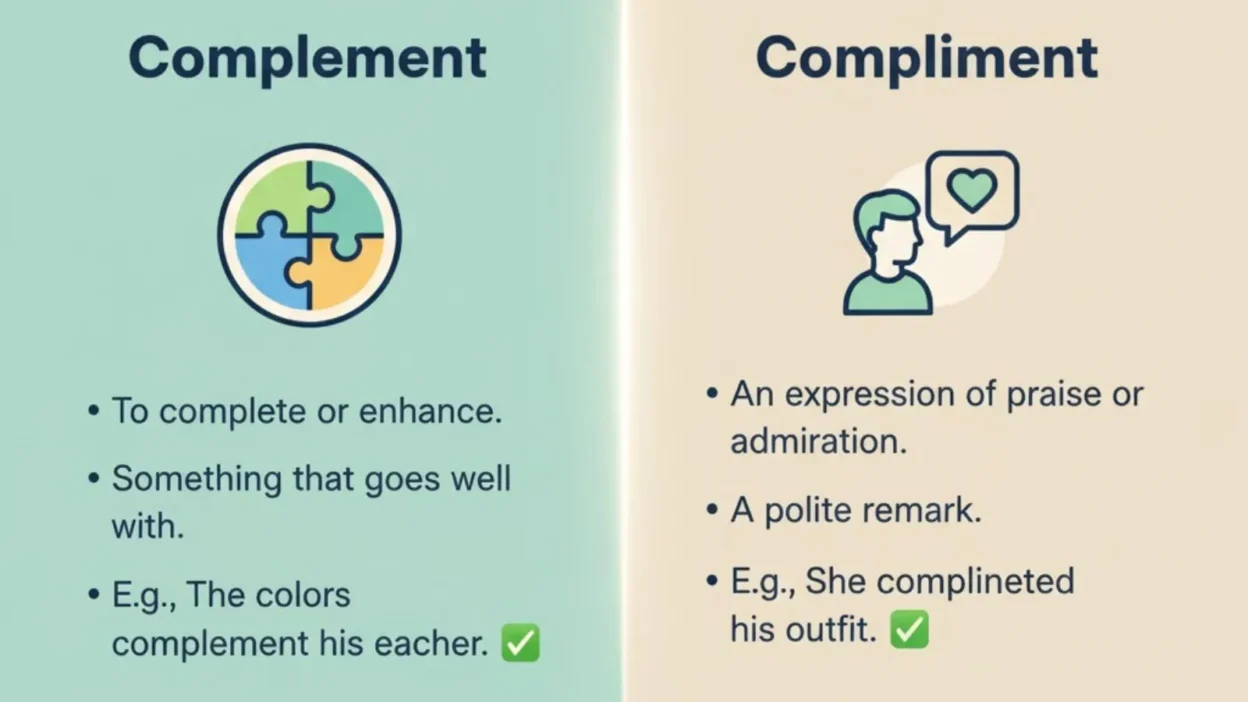
- Complement ➝ means to complete or enhance something.
- Example: “Blue shoes complement your dress.”
- Example: “Blue shoes complement your dress.”
- Compliment ➝ means to praise someone or something.
- Example: “She gave him a kind compliment.”
- Example: “She gave him a kind compliment.”
👉 Easy trick:
Compliment has “i” → think “I say something nice.”
📚 The Origin of Complement & Compliment
Both words come from Latin:
- Complement → from complementum meaning “that which completes.”
- Compliment → from complimentum, meaning “expression of respect or praise.”
Over time, English used different spellings to separate the meanings. That is why today:
- “Complement” = completion
- “Compliment” = praise
Even though they sound the same, the spelling shows the meaning. ✍️
🇬🇧 vs 🇺🇸 British English vs American English Spelling
Good news: Both words are spelled the same in UK and US English.
| Meaning | UK English | US English | Example |
| Complete/Enhance | complement | complement | These colors complement each other. |
| Praise | compliment | compliment | He gave her a compliment. |
👉 No spelling difference — only meaning matters.
🎯 Which Spelling Should You Use?
Use based on meaning:
- If you mean to enhance, complete, match → use complement
(business, design, cooking, fashion, branding) - If you mean to praise, say something nice → use compliment
(emails, messages, social interactions)
📌 For all audiences (US, UK, global):
The meaning rule stays the same everywhere. ✔️
⚠️ Common Mistakes with Complement or Compliment
Here are common errors:
| Mistake ❌ | Correction ✔️ |
| “I love your outfit. It really compliments your style.” | “It really complements your style.” |
| “She received a complement on her work.” | “She received a compliment on her work.” |
| “These two services compliment each other.” | “These two services complement each other.” |
👉 Always check: Is it praise or complete?
💬 Complement or Compliment in Everyday Examples
✔️ Emails
- “Your design skills complement our team needs.”
- “Thank you for your kind compliment on the report.”
✔️ News
- “The new policy complements earlier reforms.”
- “The minister received compliments for her speech.”
- “Your comment was a sweet compliment 😊.”
- “These colors complement each other 🔥.”
- “This software complements the existing system.”
📊 Complement or Compliment – Google Trends & Usage Data
Google Trends shows:
- “Compliment” is searched more in social contexts, like praise, comments, and kindness.
- “Complement” is popular in design, fashion, AI tools, branding, and business writing.
- Countries like the US, UK, India, Pakistan, and Canada search both terms often due to confusion.
Searches rise when people write emails, resumes, and social posts. 🔍📈
🧩 Comparison Table
| Word | Meaning | Used For | Example |
| Complement | To complete, enhance | Colors, ideas, skills, tools | “The logo complements the brand.” |
| Compliment | To praise | People, work, appearance | “Thanks for the compliment!” |
❓ FAQs
1. What is the main difference between complement and compliment?
Complement = complete / enhance.
Compliment = praise.
2. How can I remember the difference?
ComplIment → think I say something nice.
3. Are they spelled differently in UK and US English?
No, the spelling is the same.
4. Can people use them interchangeably?
No, they change the meaning of a sentence.
5. Is complement a noun or verb?
Both.
- Noun: “A good complement.”
- Verb: “These colors complement each other.”
6. Is compliment a noun or verb?
Both.
- Noun: “A compliment.”
- Verb: “She complimented him.”
7. Which is used more online?
“Compliment” is searched slightly more because people use it in daily communication.
🏁 Conclusion
Complement vs Compliment is one of the most common confusing word pairs in English. They sound exactly the same but carry different meanings, which can change your message if you choose the wrong one. Now you know that complement means to complete, enhance, or go well with something, while compliment means to praise someone.
These words are used in emails, social posts, business writing, design discussions, and everyday conversation. With this guide, you can now choose the correct spelling with confidence. You also learned their origins, common mistakes, spelling rules in US/UK English, and real-life examples to help you remember easily.
Whenever you write, ask yourself:
👉 Am I talking about praise? Use compliment.
👉 Am I talking about completing or enhancing? Use complement.
With this simple rule, you will never mix them up again. ✨📘✔️
Discover More Articles
- ✔️101+Who or Whom? The Complete Beginner Friendly Guide 2026
- 🌟 Altogether or All together What’s the Difference & When to Use Each? 2026
- 🌍 Further or Farther What’s the Right Word to Use? 2026
- ⭐ Principal or Principle What’s the Difference? (Easy Guide + Examples) 2026