Every day, people write emails, reports, essays, and social posts and many pause at the same question: Should I use despite or in spite of? 🤔✍️
The confusion is common because both phrases look similar, sound formal, and appear in professional writing.
Yet learners worry about grammar rules, tone, and which version native speakers prefer.
When users search for “Despite or In spite of”, they want a quick, clear answer. They want to know:
✔️ Are both correct?
✔️ Do they mean the same thing?
✔️ Is one more formal?
✔️ Which one should I use?
This guide solves all of that. With simple rules, examples, tables, and real-life usage, you’ll learn how to choose the right form every time. 📘✨
Whether you’re a student, writer, or English learner, this article gives you the grammar clarity you need fast, easy, and stress free.
Despite or In Spite of – Quick Answer ⚡📌
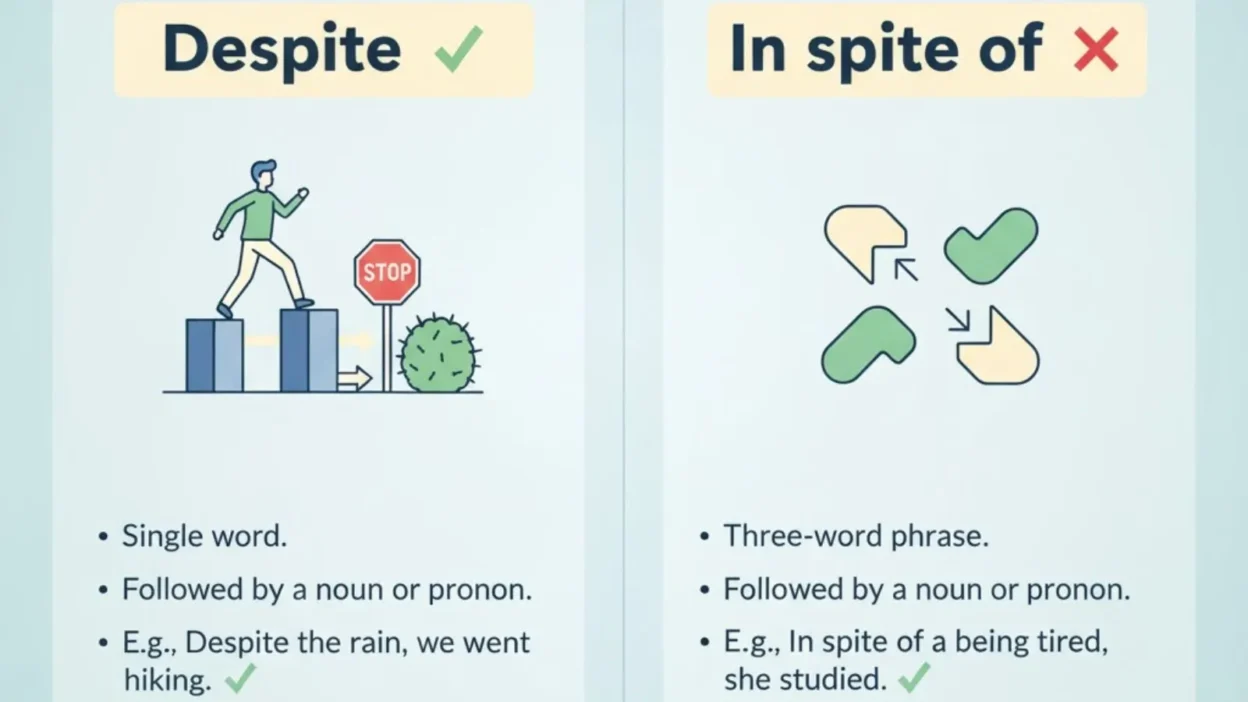
Both “despite” and “in spite of” mean the same thing: even though something happened or existed.
✅ Use “despite”
- Despite the rain, we played outside.
- Despite his efforts, he was late.
✅ Use “in spite of”
- In spite of the rain, we played outside.
- In spite of his efforts, he was late.
👉 Meaning: 100% the same
👉 Grammar: Both take a noun or gerund (-ing word)
👉 Difference: Style only — ‘despite’ is shorter and more common
The Origin of “Despite or In Spite Of” 🕰️📜
- Despite comes from Old French despit, meaning “contempt” or “scorn.”
- In spite of grew from the older phrase “in despyt of,” used in Middle English.
- Over time, meanings softened, and both phrases shifted to express contrast instead of anger.
Why spelling differences exist
Because “in spite of” is a phrase (three words) and “despite” is a single word. English kept both forms as writing styles changed over centuries.
British English vs American English Spelling 🇬🇧🇺🇸
Both English varieties accept both forms.
But usage differs:
🇺🇸 American English
- Prefers despite
- Seen in news, business, and academic writing
➡️ Despite the delay, the project continued.
🇬🇧 British English
- Uses both, but in spite of appears more often
➡️ In spite of the delay, the project continued.
Comparison Table
| Feature | Despite | In spite of |
|---|---|---|
| Words | 1 word | 3 words |
| Common in US | ⭐⭐⭐⭐⭐ | ⭐⭐⭐ |
| Common in UK | ⭐⭐⭐⭐ | ⭐⭐⭐⭐ |
| Formality | Neutral | Slightly formal |
| Meaning | Same | Same |
| Followed by | Noun/gerund | Noun/gerund |
Which Spelling Should You Use? 🎯📝
✔️ Use “despite” if:
- Your audience is American
- You want clear, short writing
- You prefer modern style
✔️ Use “in spite of” if:
- Your audience is British/Commonwealth
- You want a slightly formal tone
- You are writing literature, essays, or speeches
🌍 For global audiences
Both forms are correct — but “despite” is safer and simpler.
Common Mistakes with Despite or In Spite Of ❌📌
❌ Wrong: Despite of the rain…
✅ Correct: Despite the rain…
❌ Wrong: Inspite of the delay…
✅ Correct: In spite of the delay…
❌ Wrong: Despite he was tired…
✅ Correct: Despite being tired…
(or Despite the fact that he was tired)
Despite or In Spite of in Everyday Examples 🌍💬
📧 Email (Professional)
- Despite the short notice, we completed the task.
- In spite of the issue, the system stayed online.
📰 News Headlines
- Economy grows despite global pressure.
- Team wins in spite of major injuries.
📱 Social Media
- Went hiking despite the cold! ❄️⛰️
- In spite of challenges, I’m staying positive 💪✨
📄 Formal Writing
- Despite the evidence, the theory remains debated.
- In spite of earlier reports, the results improved.
Despite or In Spite Of – Google Trends & Usage Data 📊🌎
- Worldwide, “despite” is more searched — short, simple, and common.
- In the UK, India, Pakistan, and Nigeria, both terms appear often.
- In the US, “despite” dominates news, blogs, and essays.
- Social platforms also prefer despite because it’s faster to type.
Keyword Variations Comparison Table 🔍📘
| Keyword | Meaning | Popularity |
|---|---|---|
| Despite | Most common | ⭐⭐⭐⭐⭐ |
| In spite of | Slightly formal | ⭐⭐⭐⭐ |
| Despite of ❌ | Incorrect | ⭐ |
| In spite | Incomplete | ⭐⭐ |
FAQs ❓✨
1. Are “despite” and “in spite of” the same?
Yes. Both mean even though something happened.
2. Is “despite of” correct?
No. The correct form is “despite” only.
3. Which is more formal?
“In spite of” sounds a bit more formal.
4. Can I use a verb after “despite”?
Yes, but it must be in -ing form.
➡️ Despite working hard…
5. Which is better for academic writing?
Both are accepted, but despite is cleaner.
6. Is “inspite” one word?
No. Always in spite of (three words).
7. Which is more common worldwide?
“Despite” is the most common form globally.
Conclusion 🌟📝
Deciding between “despite” and “in spite of” does not have to be confusing. Both expressions share the same meaning and follow the same grammar rules. The only real difference is style. “Despite” is short, modern, and widely used. “In spite of” is longer, slightly formal, and common in British English.
If you write for a global audience, choosing despite keeps your sentences simple and clear. If you want a formal or traditional tone, in spite of is a good option. Avoid common mistakes like “despite of” and remember that both forms must be followed by a noun or an -ing verb.
When you understand how both phrases work, your writing becomes more confident, smooth, and correct. Now you can use the right form every time — in emails, essays, reports, and everyday conversation. ✨✍️
In short: Both are correct. Pick the one that fits your style and audience.
Discover More Articles
- Worshiping or Worshipping Which Spelling Is Right? 2026🙏
- 🌟 Whether or If What’s the Difference? (Full Guide + Examples) 🌟2026
- 🌟Because of or Due to What’s the Difference? (Complete Guide) ✨📘 2026
- ✨101+Although or Though Which One Should You Use? 2026✨