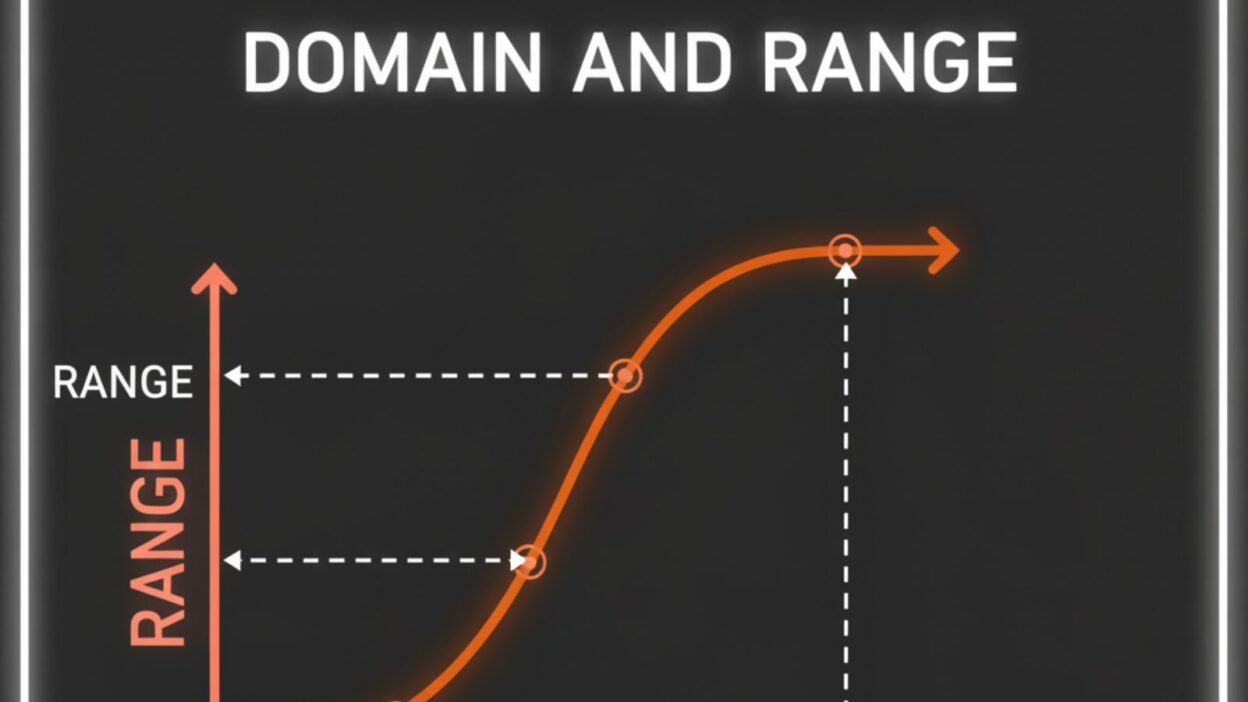
Understanding domain and range is a key part of algebra and functions in mathematics.
Students search for this topic when learning graphs, functions, or preparing for exams.
Many people get confused because domain and range may look similar, but they are not the same.
This guide explains both terms in a simple way with examples, tables, and FAQs.
Domain and Range – Quick Answer
Domain and range describe the input and output values of a function.
| Term | Meaning | Simple Example |
|---|---|---|
| Domain | All possible input values (x) | If f(x) = x + 2, domain is all real numbers |
| Range | All possible output values (y) | If f(x) = x + 2, range is all real numbers |
✅ For the function f(x) = 2x + 3
- Domain: All real numbers
- Range: All real numbers
✅ For the function f(x) = √x
- Domain: x ≥ 0
- Range: y ≥ 0
The Origin of “Domain and Range”
The ideas of domain and range come from set theory and function notation developed in the 18th–19th centuries.
- Domain comes from Latin dominium, meaning “control or ownership”—the values you control in a function.
- Range comes from Old French rangier, meaning “a line or row”, referring to the spread of output values from a function.
Mathematicians like Leonhard Euler helped develop these ideas to make functions clear and consistent.
British English vs American English Usage
Unlike spelling rules such as colour vs color, the terms domain and range are spelled the same in both British and American English. However, usage style in textbooks can differ slightly.
| Aspect | British Style | American Style |
|---|---|---|
| Definition style | Input values are called the domain | The domain is the set of input values |
| Notation preference | Uses f : X → Y form | Uses y = f(x) form |
| Graph explanations | More formal explanations | More visual explanations |
Which Usage Should You Follow?
Choose based on your audience:
| Audience | Suggested Style |
|---|---|
| US schools or exams (SAT, ACT) | American explanation style |
| UK/Commonwealth (GCSE, A-Level) | British formal notation |
| Global readers | Simple style + examples |
✅ Best choice: Use clear and simple wording with examples, no matter where you are.
Common Mistakes with Domain and Range
Here are frequent errors:
| Mistake | Correction |
|---|---|
| Mixing input and output | Domain = input (x), Range = output (y) |
| Forgetting restrictions | √x means x ≥ 0 (not all real numbers) |
| Dividing by zero | If f(x) = 1/x, x ≠ 0 |
| Ignoring graph boundaries | Range depends on graph shape |
| Missing context | Real-life functions have limits (e.g. negative time is not valid) |
Domain and Range in Everyday Examples
Domain and range are not just math terms – we use them in real life too.
| Real-Life Case | Domain | Range |
|---|---|---|
| Temperature conversion: F = (9/5)C + 32 | All real temperatures | All real temperatures |
| Taxi fare: F(x) = 200 + 50x (in PKR) | x ≥ 0 km | F(x) ≥ 200 |
| Height of a child (age vs height) | Age 0–18 | Height 45–180 cm |
Example sentence uses:
- Email: “Please define the domain and range in your graph explanation.”
- News: “Analysts studied the domain and range of the data set across five years.”
- Social media: “Math is easy when you understand domain and range!”
Domain and Range – Google Trends & Usage Data
People search “domain and range” most in countries where competitive exams include algebra.
| Country | Search Interest |
|---|---|
| United States | High |
| India | Very High |
| Pakistan | High |
| Philippines | High |
| UK | Medium |
Trending keywords:
| Keyword Variation | Search Intent |
|---|---|
| domain and range calculator | Quick solver |
| domain and range examples | Learning help |
| find domain and range | Math solution |
| domain and range graph | Visual help |
Comparison Table – Keyword Variations
| Keyword | Meaning | Use |
|---|---|---|
| domain and range | Main keyword | Study concept |
| domain of function | Input-focused term | Classroom |
| range of function | Output-focused term | Classroom |
| domain and range examples | Tutorial search | SEO keyword |
| domain and range maths | Used in UK/India | British English |
FAQs – Domain and Range
1. What is domain in simple words?
Domain is the set of all valid input values (x) for a function.
2. What is range in simple words?
Range is the set of all possible output values (y) from a function.
3. How do I find the domain?
Check for:
- No division by zero
- No square root of negative numbers
- No log of zero or negative values
4. Does every function have a domain and range?
Yes, every function has both, but some are restricted based on the function rule.
5. What is the domain of 1/(x–3)?
All real numbers except x = 3.
6. What is the domain of √(x–4)?
x – 4 ≥ 0 ⇒ x ≥ 4.
7. What is the range of y = x²?
y ≥ 0.
Conclusion
Understanding domain and range helps you know which values are acceptable in a function and what outputs they can produce. The domain controls the input, while the range measures the output. These concepts are essential in algebra, calculus, physics, and even real life—like money, age, and distance problems. If you remember one thing, remember this:
✅ Domain → x-values (input)
✅ Range → y-values (output)
Learning domain and range builds a strong foundation for advanced math topics. With examples, formulas, and graph rules, you can master this concept step by step. Keep practicing, and it will become easy.
Discover More Articles
- 🌞 Good Morning or Goodmorning Which Is Correct? 2026
- 101+Anyway vs Anyways What’s the Difference and Which Is Correct? 2026
- 101+Prefer or Perfer What Is the Correct Spelling? (2026)
- Hippy or Hippie Which Spelling Is Correct and When to Use Each? 2026