Many English learners pause when they write or speak phrases like “help each other” or “support one another.” 😕
Why? Because both expressions seem similar, yet people wonder if one is more correct than the other.
This confusion makes thousands search for the keyword “each other or one another” every month. 🔍
The truth is simple: both are used to show a mutual or shared action between people.
But small differences in grammar history, regional preference, and writing style create uncertainty.
Writers want to know which phrase looks more professional, which fits modern English, and whether US and UK English treat them differently. ✍️
This guide solves that confusion in a clear, friendly way.
You’ll learn the quick answer, the origin of each phrase, British vs American usage, common mistakes, real-life examples, and even Google Trends insights. 📊
By the end, you will know exactly when to use each other and one another, and your writing will become smooth, confident, and correct. ✔️
💡 Each Other or One Another – Quick Answer
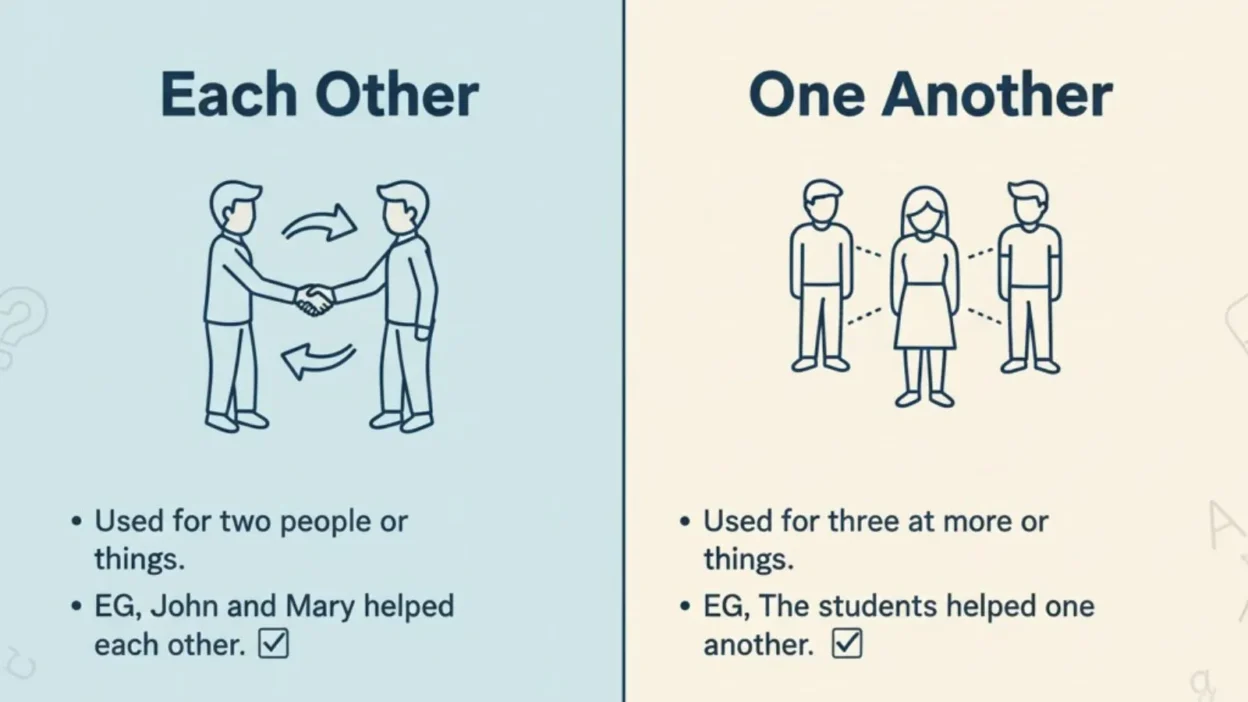
Both each other and one another mean the same thing: a mutual action between two or more people. 🤝
Examples:
- “Ali and Sara help each other.”
- “The students encouraged one another.”
In modern English, both phrases are correct and interchangeable.
📜 The Origin of “Each Other” and “One Another”
- Each other comes from Old English and was used as early as the 1500s.
- One another appeared later, around the 1600s.
- Early grammarians tried to create a rule:
- Use each other for two people.
- Use one another for three or more.
- This rule is no longer followed in modern English, but many still believe it exists—causing the confusion you’re trying to solve today. 😅
🇬🇧 British English vs 🇺🇸 American English Usage
Both British and American English use each other and one another, but the frequency differs.
Usage Trend:
- American English prefers: each other
- British English uses both more evenly
- Formal writing sometimes prefers one another
Comparison Table
| Variation | American English 🇺🇸 | British English 🇬🇧 | Notes |
|---|---|---|---|
| Each other | Most common | Very common | Sounds modern + simple |
| One another | Less common | Common | Slightly more formal |
🎯 Which Spelling Should You Use?
Use the version that matches your audience:
- For US readers:
→ Prefer each other (more natural in American English). 🇺🇸 - For UK or Commonwealth readers:
→ Use either, but one another can feel slightly formal. 🇬🇧🇵🇰🇦🇺 - For global/general audience:
→ Choose each other because it is shorter, clearer, and widely recognized. 🌍
⚠️ Common Mistakes with Each Other or One Another
| Mistake ❌ | Correct Form ✔️ |
|---|---|
| “They looked to each another.” | “They looked to each other.” |
| “They respect one each other.” | “They respect one another.” |
| “The team members helped one and other.” | “The team helped one another.” |
| Using possessive incorrectly: “each other’s’s.” | “each other’s phones.” |
Tip:
Never use each other’s with extra “s” or plural “each others”. 🙅♂️
📌 Each Other or One Another in Everyday Examples
Email Example 📧
- “Thank you for helping each other during the project.”
Social Media Example 📱
- “Let’s support one another through hard times. ❤️”
News Example 🗞️
- “Both teams congratulated each other after the match.”
Formal Writing Example 📝
- “The delegates expressed hope for working with one another in future programs.”
📊 Each Other or One Another – Google Trends & Usage Data
Based on global search patterns:
- “Each other” is searched far more often worldwide.
- “One another” has steady but lower search volume.
- Popular in countries like the US, UK, Pakistan, India, Canada, Australia, and the Middle East.
- Searches spike during:
- school exams 📚
- grammar tests ✏️
- professional writing improvements 🧑💼
Trend Table
| Keyword | Popularity | Countries |
|---|---|---|
| Each other | High | US, UK, India, Pakistan |
| One another | Medium | UK, Australia, Canada |
📄 Comparison Table (Keyword Variations Side by Side)
| Keyword | Meaning | Formality | Best Usage |
|---|---|---|---|
| Each other | Mutual action | Neutral | Everyday writing |
| One another | Mutual action | Slightly formal | Reports, speeches |
| Eachother | ❌ Incorrect | — | Never use |
| Oneanother | ❌ Incorrect | — | Never use |
❓ FAQs
1. Is there a difference between “each other” and “one another”?
No. Both mean the same thing in modern English.
2. Is “eachother” one word?
No. It must be two words: each other.
3. Is “oneanother” correct?
No. Always write one another as two words.
4. Which is more formal?
One another is slightly more formal.
5. Can I use them for more than two people?
Yes. You can use both for two or more people.
6. What should I use in business writing?
Both are correct, but one another can sound more professional.
7. Which is more common in daily life?
Each other is more common and feels simpler.
📝 Conclusion
Choosing between each other and one another does not need to be confusing. Both expressions show a shared or mutual action, and modern English accepts them as 100% interchangeable. While older grammar rules suggested using “each other” for two people and “one another” for groups, those rules no longer apply today.
Still, style preferences matter. If you write for Americans, “each other” will feel natural. For British or Commonwealth readers, either version works well. For formal writing, “one another” may add a polished tone, while “each other” fits casual, friendly language.
When you understand audience, tone, and clarity, choosing the right phrase becomes easy. Whether you are writing an email, a report, a school assignment, or social media content, both phrases help you express togetherness, cooperation, and human connection. 🤝
So use the one that feels right for your message—and write with confidence knowing you’re grammatically correct every time. ✔️
Discover More Articles
- 🌟 Few or A Few What’s the Difference? A Simple Guide to Clear English Usage 🌟 2026
- 🌟 Since or Because What’s the Difference & Which One Should You Use? 2026
- 🌟 Among or Between Meaning, Usage & Simple Guide 🌟 2026
- Maybe or May be What’s the Right Choice? 😕 2026