In today’s digital world, everyone talks about sending an email.
But sometimes you might see it written as e-mail and wonder: which is correct? 🤔
This confusion arises because both forms are widely used, and English spelling rules vary between regions.
Many people search for “Email or E-mail” to get a clear answer, especially writers, students, and professionals who want to stay correct in emails, documents, or publications.
Understanding the difference is not just about spelling—it’s about proper communication.
Whether you’re writing for a UK audience, US readers, or global platforms, knowing when to use email or e-mail can make your content look professional and polished.
In this article, we’ll break it down with examples, history, and expert advice, so you’ll never be unsure again. ✅
Email or E-mail – Quick Answer ✨
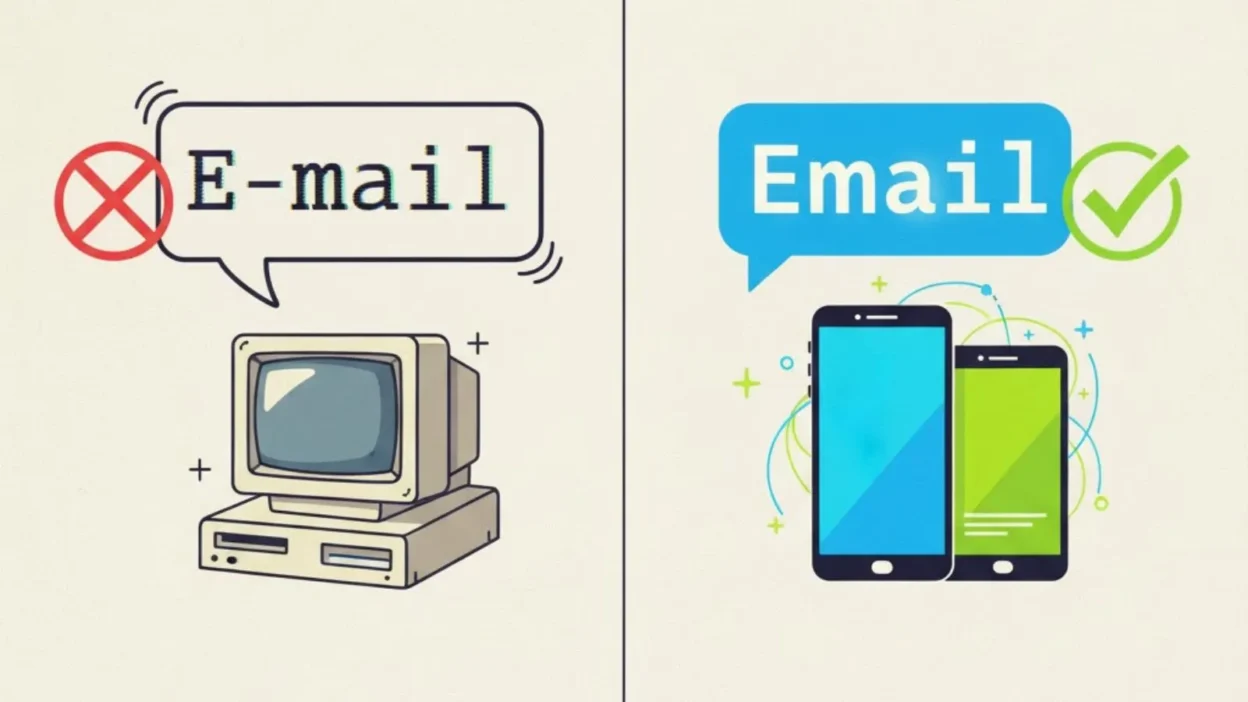
The quick answer is: both are correct, but “email” (without the hyphen) is more modern and widely accepted today.
- Email → Standard, preferred in most writing and online platforms.
Example: I sent you an email yesterday. - E-mail → Older form, still used in formal or traditional writing.
Example: Please check your e-mail for updates.
💡 Tip: Use email for simplicity unless a style guide specifically asks for e-mail.
The Origin of Email or E-mail 📜
The term comes from “electronic mail”, shortened to e-mail in the 1970s and 1980s. Back then, hyphens were common in new compound words. Over time, as technology became mainstream, the hyphen was dropped for convenience, resulting in email.
- E-mail → 1970s–1990s, formal computing manuals.
- Email → 2000s onwards, popularized by internet and mobile use.
The spelling difference is similar to other words like website (formerly web-site)—language evolves to be simpler.
Email vs E-mail ✨
The quick answer is: both are correct, but “email” (without the hyphen) is more modern and widely accepted today.
- Email → Standard, preferred in most writing and online platforms.
Example: I sent you an email yesterday. - E-mail → Older form, still used in formal or traditional writing.
Example: Please check your e-mail for updates.
💡 Tip: Use email for simplicity unless a style guide specifically asks for e-mail.
British English vs American English Spelling 🇬🇧🇺🇸
Spelling preferences vary slightly between British and American English, but both accept email.
| Feature | British English | American English |
| Common usage | email or e-mail | |
| Formal writing | e-mail still seen in newspapers | email dominates |
| Informal writing | email preferred | email preferred |
✅ Key takeaway: The hyphen is rarely necessary unless following an older style guide.
Which Spelling Should You Use? 🎯
- US audience: Always use email.
- UK & Commonwealth: Email is preferred, but e-mail is accepted in traditional contexts.
- Global audience: Stick to email for clarity and modern style.
💡 Pro tip: When in doubt, check your audience or follow the publication’s style guide.
Common Mistakes with Email or E-mail ❌
- Using “Email” as a verb incorrectly:
- Wrong: I will e-mailing you tomorrow.
- Correct: I will email you tomorrow.
- Wrong: I will e-mailing you tomorrow.
- Hyphen overuse in modern text:
- Wrong: Please send an e-mail today. (okay but outdated)
- Correct: Please send an email today.
- Wrong: Please send an e-mail today. (okay but outdated)
- Capitalization errors:
- Wrong: Email vs email
- Correct: Always lowercase email unless starting a sentence.
- Wrong: Email vs email
Email or E-mail in Everyday Examples 📱💻
- Emails: “I received your email regarding the project.”
- News articles: “Companies now rely on email for official communication.”
- Social media: “DMs are common, but email is still professional.”
- Formal writing: “Please submit your application via email.”
Email or E-mail – Google Trends & Usage Data 📊
- Email has seen a steady rise in searches since the 2000s.
- E-mail usage declines as style guides prefer modern spelling.
- Most searches come from US, UK, Canada, and Australia, with email dominating global results.
Keyword Comparison Table 🔍
| Version | Popularity | Use Case | Notes |
| ✅ High | All modern writing | Standard spelling globally | |
| ⚠️ Medium | Formal or historical context | Becoming rare, mostly UK newspapers |
FAQs ❓
- Is email or e-mail correct?
Both are correct, but email is modern and preferred. - Can I use e-mail in official documents?
Yes, but only if following a style guide. - Why did e-mail lose the hyphen?
Language evolved for simplicity; internet communication favored email. - Which is better for professional writing?
Use email for clarity and modern standards. - Do search engines prefer email or e-mail?
Email is more SEO-friendly due to higher search frequency. - Is there a difference in meaning?
No, both refer to electronic mail. - How should I spell it in emails?
Always use lowercase email, unless at the start of a sentence.
Conclusion ✨
In the debate of Email or E-mail, the modern choice is clear: email. It’s simpler, widely accepted, and preferred in most writing styles. E-mail is still valid in traditional or formal contexts, especially in older publications or UK formal writing.
By understanding the origin, regional preferences, and common mistakes, you can confidently use email in everyday communication, from casual messaging to professional documents. ✅ Remember, the key is consistency—pick one style and stick to it for clarity and professionalism.
Discover More Articles
- Everytime or Every time Which One is Correct? 🤔 2026
- 101 + Alright or All right Which One Is Correct? 🤔✍️ 2026
- ✅ Anymore or Any more What’s the Correct Spelling? 2026
- 💡 Noone or No One Which Is Correct? The Definitive Grammar Guide (With Examples) 2026