Have you ever paused mid-sentence wondering — “Should I write ensure or insure?” 🤔You’re not alone!
Millions of people search for this exact phrase every month because these two words sound identical but have different meanings and uses.
The confusion arises because both ensure and insure deal with making something certain — yet they’re used in different contexts.
Understanding when to use each will not only sharpen your grammar but also make your writing sound more professional.
In this quick guide, you’ll get:
✅ A short answer you can memorize instantly.
✅ A simple history of both words.
✅ Clear US 🇺🇸 vs UK 🇬🇧 spelling tips.
✅ Real-world examples and a comparison table.
Let’s clear up this spelling mystery once and for all! 🕵️♀️
⚡ Ensure or Insure – Quick Answer
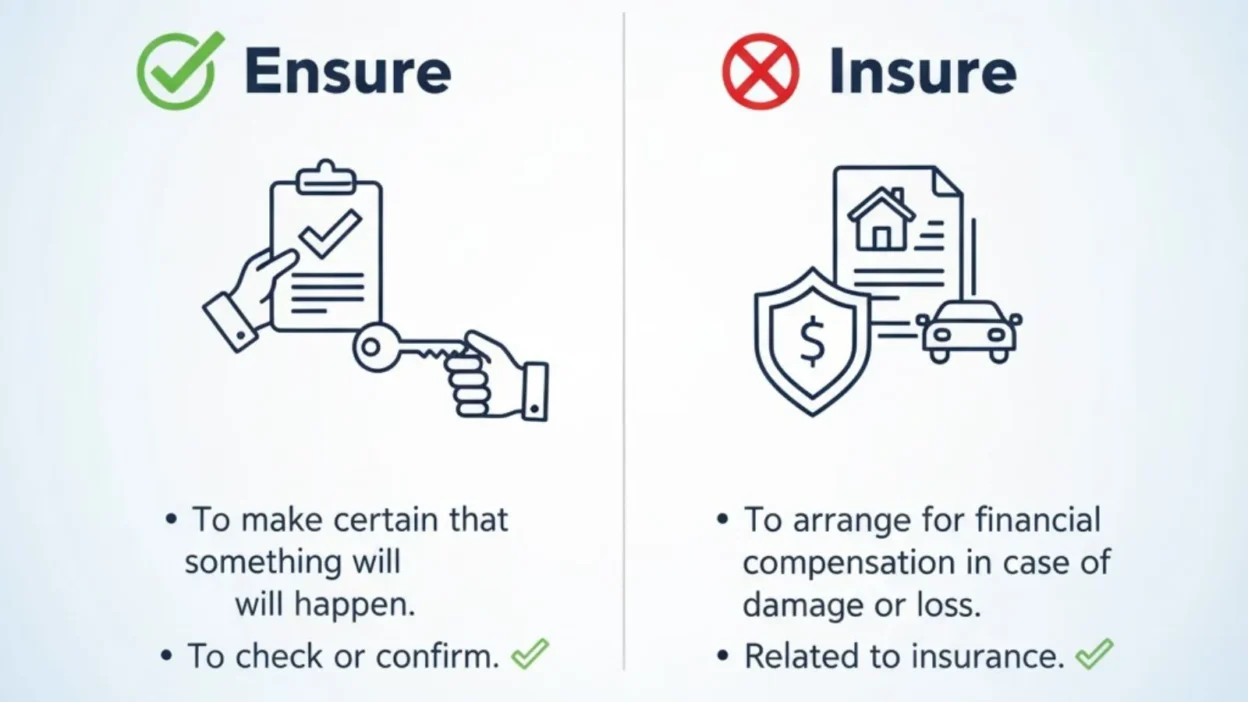
👉 Ensure = To make sure or guarantee something.
👉 Insure = To protect financially (especially with insurance).
Examples:
- ✅ I will ensure that the door is locked.
- ✅ I will insure my car against theft.
So remember: Ensure = make sure, Insure = insurance 💡
📜 The Origin of “Ensure” and “Insure”
Both words come from the Old French word “enseurer”, meaning to make sure or secure.
Over time, the English language evolved — and “insure” started being used specifically for financial protection, while “ensure” remained more general.
- Ensure appeared in English around the 1500s.
- Insure became common in the 1600s, especially in the context of insurance contracts.
The spelling split helped readers quickly identify meaning based on context, not sound.
🇬🇧 vs 🇺🇸 British English vs American English Spelling
Both ensure and insure exist in UK and US English — but their usage preferences differ slightly.
| Context | British English 🇬🇧 | American English 🇺🇸 |
|---|---|---|
| Making sure / Guarantee | ✅ Ensure | ✅ Ensure |
| Financial protection | ✅ Insure | ✅ Insure |
| Alternative spelling (rare) | Sometimes “ensure” used in both meanings | Clear distinction: “ensure” ≠ “insure” |
💬 Tip: Americans are stricter with the difference, while British speakers may use them more interchangeably in casual writing.
🎯 Which Spelling Should You Use?
Here’s a simple rule of thumb 👇
- 🌍 Writing for a global or academic audience: Use ensure (it’s clear and universal).
- 🇺🇸 Writing for American readers: Use ensure for certainty, insure for financial protection.
- 🇬🇧 Writing for British or Commonwealth readers: You may occasionally see insure used like ensure, but sticking to the American rule keeps your writing crystal clear.
✅ Best practice: Always use ensure unless you’re talking about insurance.
⚠️ Common Mistakes with “Ensure” or “Insure”
🚫 Incorrect: I will insure that everyone attends the meeting.
✅ Correct: I will ensure that everyone attends the meeting.
🚫 Incorrect: Please ensure your car against damage.
✅ Correct: Please insure your car against damage.
💡 Quick check: If money or coverage is involved → insure. Otherwise → ensure.
💬 “Ensure” or “Insure” in Everyday Examples
In emails:
✉️ “Please ensure that all reports are submitted by Monday.”
In news headlines:
📰 “Government aims to ensure equal access to education.”
🗞️ “Drivers urged to insure vehicles before deadline.”
On social media:
📱 “I always ensure my coffee is perfect before work ☕.”
💸 “Time to insure my new phone 📱.”
In formal writing:
🖋️ “Policies are designed to ensure compliance with regulations.”
📊 “Ensure or Insure” – Google Trends & Usage Data
Google Trends shows that:
- 🌎 “Ensure” is searched 2× more often than “Insure” globally.
- 🇺🇸 In the U.S., “insure” spikes around tax and insurance seasons.
- 🇬🇧 In the U.K., both terms appear in formal writing, but ensure still dominates.
| Country | Most Popular Word | Typical Context |
|---|---|---|
| USA 🇺🇸 | Ensure | General writing, education |
| UK 🇬🇧 | Ensure | Government, policy, business |
| Canada 🇨🇦 | Insure | Insurance and finance |
| Australia 🇦🇺 | Ensure | Common speech & writing |
❓ FAQs About “Ensure or Insure”
1. Are “ensure” and “insure” interchangeable?
👉 No. “Ensure” = make sure. “Insure” = protect financially.
2. Can I use “insure” in British English for both meanings?
👉 Technically yes, but modern grammar prefers the distinction.
3. Which is more formal: ensure or insure?
👉 “Ensure” is more common in formal and academic writing.
4. What’s the difference between ensure, insure, and assure?
👉 Ensure = make sure. Insure = protect financially. Assure = make someone confident.
5. Is “insure” only for money?
👉 Mostly yes — it refers to insurance or risk coverage.
6. How do I remember the difference?
👉 Think INSURE = INSURANCE. Easy! 💡
7. Is it wrong to use “insure” instead of “ensure”?
👉 In casual UK writing, not always — but for clarity, use “ensure”.
🏁 Conclusion
So, when it comes to Ensure vs Insure, the key is context:
- Use Ensure when you mean to make sure.
- Use Insure when talking about financial protection or coverage.
By remembering this simple distinction, you’ll write with confidence, professionalism, and clarity — no matter where your readers are from 🌍.
✍️ Pro tip: If you’re ever unsure, ensure is the safer choice in almost every context!
Discover More Articles
- 🌟 Everyday or Every day What’s the Real Difference? 2026
- 🌟 Lay or Lie What’s the Difference? (A Simple Grammar Guide) 2026
- Passed or Past ✅ Quick Guide to Using Them Correctly 2026
- ✅ Accept or Except What’s the Real Difference? 2026