Have you ever typed “everyday” and then wondered, wait… should that be two words? 🤔
You’re not alone! Thousands of people search “everyday or every day” every month, trying to figure out which is correct and why both seem right in different sentences.
The confusion happens because both “everyday” and “every day” exist in English, but they mean different things.
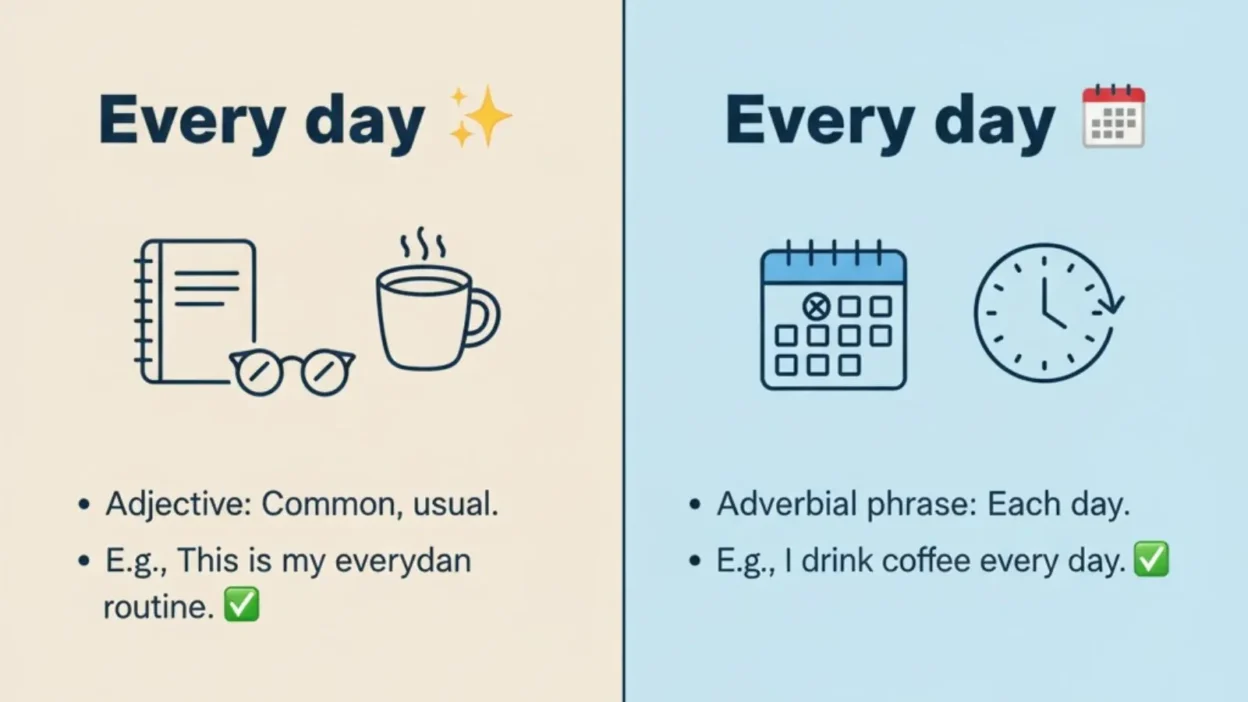
One is an adjective, and the other is an adverbial phrase.
Knowing when to use each one makes your writing look more natural, polished, and professional.
This article will help you clearly understand the difference, explore word origins, and give real-world examples — so you’ll never second-guess this common pair again! 💡
✅ Everyday or Every day – Quick Answer
Here’s the short and simple rule 👇
| ✅ Correct Usage | ❌ Incorrect Example |
| Everyday = one word → adjective → “ordinary” or “regular.” | “I go to work everyday.” (❌) |
| Every day = two words → means “each day.” | “These are my every day clothes.” (❌) |
👉 Examples:
- ✅ These are my everyday shoes. (ordinary shoes)
- ✅ I go for a walk every day. (each day)
💡 Tip: If you can replace it with each day, use two words.
📜 The Origin of “Everyday or Every day”
The word “everyday” evolved from the phrase “every day” centuries ago. Originally, it was always two words, but as English simplified, frequent phrases began merging.
📚 “Everyday” as a single word appeared around the 15th century, when writers started using it as an adjective to describe ordinary or habitual things — like “everyday life.”
So, the spelling difference is historical: one stayed a phrase (every day), and the other became a word (everyday) through evolution and usage.
🇬🇧 British English vs 🇺🇸 American English Spelling
Both British and American English use everyday and every day in the same way. However, usage trends may vary slightly in frequency and style preferences.
🔠 Comparison Table
| Variant | Region | Meaning | Example |
| Everyday | US 🇺🇸 / UK 🇬🇧 | Common, ordinary | “These are my everyday clothes.” |
| Every day | US 🇺🇸 / UK 🇬🇧 | Each day | “I go jogging every day.” |
📊 According to Google Ngram, “every day” appears more frequently in both versions of English because it fits broader contexts.
💬 Which Spelling Should You Use?
Here’s a simple guide 🎯
| Audience | Recommended Form | Why |
| 🇺🇸 US Readers | Both (same rules) | Grammar rules are identical in American English |
| 🇬🇧 UK Readers | Both (same rules) | No variation in meaning or spelling |
| 🌍 Global Audience | Follow standard usage | Use “every day” when in doubt; it’s safer and clearer |
👉 Use “everyday” when describing something.
👉 Use “every day” when talking about time or frequency.
⚠️ Common Mistakes with “Everyday or Every day”
Here are a few common slip-ups and how to fix them:
| Mistake ❌ | Correct ✅ | Explanation |
| “She prays everyday.” | “She prays every day.” | It means each day, not ordinary. |
| “It’s an every day problem.” | “It’s an everyday problem.” | It describes a regular issue. |
| “He drinks tea everyday morning.” | “He drinks tea every day in the morning.” | Grammar and clarity fix. |
💡 Remember: “Everyday” = adjective → always before a noun.
📰 Everyday or Every day in Everyday Examples
See how both forms appear in different contexts:
📧 Email Example:
“Thank you for your everyday support.” (adjective)
“We check our inbox every day.” (time/frequency)
🗞️ News Example:
“These are everyday heroes.”
💬 Social Media Example:
“Gratitude every day keeps the stress away!”
📚 Formal Writing Example:
“Health is maintained by simple everyday habits.”
👉 Once you spot the pattern, you’ll never confuse them again!
📊 Everyday or Every day – Google Trends & Usage Data
According to Google Trends (2024), searches for “Everyday or Every day” are highest in:
| Country 🌍 | Popular Form | Interest Level |
| United States 🇺🇸 | Every day | 🔥 85% |
| United Kingdom 🇬🇧 | Everyday | 🔥 75% |
| Canada 🇨🇦 | Every day | 70% |
| Australia 🇦🇺 | Everyday | 65% |
| India 🇮🇳 | Every day | 80% |
📈 Insight: Most learners confuse them when writing formal emails or essays — making this one of the most searched grammar questions globally!
❓ FAQs About “Everyday or Every day”
1️⃣ Is “everyday” one word or two?
Both exist — “everyday” (adjective) and “every day” (phrase).
2️⃣ How do I know which to use?
Replace it with each day. If it fits, use every day.
3️⃣ Can “everyday” start a sentence?
Yes, if it modifies a noun. Example: “Everyday routines matter.”
4️⃣ Is “everyday life” correct?
✅ Yes. It means ordinary, daily life.
5️⃣ Is “everyday” formal?
Yes — perfectly fine in professional or academic writing.
6️⃣ What part of speech is “everyday”?
It’s an adjective.
7️⃣ What part of speech is “every day”?
It’s an adverbial phrase.
🏁 Conclusion
In short — both forms are correct, but they mean different things:
- Everyday (one word) → describes something ordinary or common.
- Every day (two words) → means each day in time.
🌈 Whether you’re writing emails, essays, or social posts, remembering this simple distinction makes your writing sharper and more confident.
Whenever you’re unsure, try this quick test:
👉 If you can replace it with “each day,” write every day.
👉 If it describes a noun, use everyday.
Master this tiny rule, and your writing will feel smoother, smarter, and more natural — every day! 💫
Discover More Articles
- ✅ Ensure or Insure What’s the Difference & Which Should You Use? 2026
- ✅ Accept or Except What’s the Real Difference? 2026
- Passed or Past ✅ Quick Guide to Using Them Correctly 2026
- 🌟 Lay or Lie What’s the Difference? (A Simple Grammar Guide) 2026