Every day, millions of English learners type “Few or A few” into Google, hoping to understand one simple thing: Which one should I use? 🤔✨
The confusion is real both expressions look almost identical, yet their meanings differ in big ways. One sounds negative, the other hopeful.
One suggests almost nothing, while the other suggests something. Such small differences can completely change the meaning of your sentence.
People search for this keyword because it affects everyday writing emails, conversations, exams, job applications, academic papers, and even social media captions.
One wrong phrase can send the wrong message.
This article gives you a quick answer upfront, then dives deeper into examples, origins, rules, common mistakes, trends, and writing tips using simple language anyone can understand. 💡✍️
By the end, you’ll know exactly when to use “few” and when to use “a few”, without second-guessing yourself again.
⚡ Few or A Few – Quick Answer
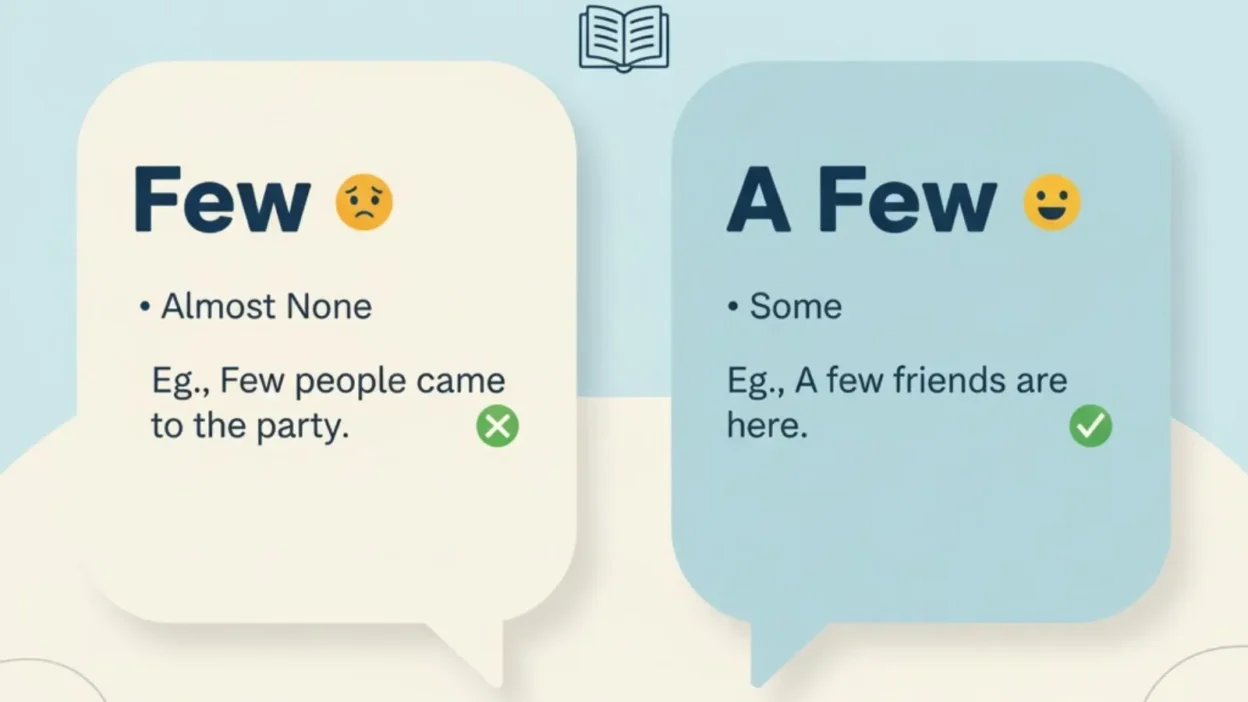
✔ “Few” = almost none (negative meaning).
✔ “A few” = some (positive meaning).
Examples:
- Few people came to the event. → Almost no one came 😕
- A few people came to the event. → Some people came 🙂
- Few options are available. → Very limited choices
- A few options are available. → There are some good choices
👉 Tip:
If the meaning feels sad, disappointing, or negative → use few.
If the meaning feels positive or hopeful → use a few.
📜 The Origin of “Few” and “A Few”
The word “few” comes from Old English “feawa”, meaning not many.
Over time, English speakers added the article “a” before “few” to soften the meaning—creating “a few”, which implies some instead of almost none.
This difference developed naturally as English evolved:
- “Few” kept its strict meaning of scarcity.
- “A few” became a friendlier, more encouraging version.
There are no spelling differences, but the meaning shift happened because English uses small words (like “a”) to change tone.
🇬🇧🇺🇸 British English vs American English
Good news:
👉 There is NO spelling difference between British and American English for “few” or “a few.”
But usage tone can differ slightly:
- American English uses “a few” more often in casual speech.
- British English sometimes uses “few” in a more formal or polite tone.
✅ Comparison Table
| Expression | Meaning | Tone | UK Usage | US Usage |
|---|---|---|---|---|
| few | almost none | negative | common | common |
| a few | some | positive | very common | very common |
🎯 Which Form Should You Use?
It depends on your audience:
🇺🇸 For American Readers:
Use “a few” more often. It’s friendlier and more conversational.
🇬🇧🇦🇺🇨🇦 For UK/Commonwealth Readers:
Both forms are used equally, but “few” may appear more in formal writing.
🌍 For Global Readers:
Prefer “a few” in general communication—it is easier for learners.
👉 General Rule:
If you want clarity and positivity → a few
If you want to show lack or scarcity → few
❌ Common Mistakes with “Few or A Few”
Mistake 1:
❌ “I have a few money.”
✔ Money is uncountable →
“I have little money.”
Mistake 2:
❌ “Few friends helped me, so I felt supported.”
✔ Negative meaning doesn’t match →
“A few friends helped me, so I felt supported.”
Mistake 3:
❌ “A few” used when the meaning is negative
Example:
❌ “A few students passed the very difficult exam.” (sounds like many passed)
✔ “Few students passed…”
📝 “Few or A Few” in Everyday Examples
📧 Email:
- “I have a few questions about the project.”
- “Few applicants met all requirements.”
📰 News:
- “Few regions reported rainfall this week.”
📱 Social Media:
- “I took a few photos today 📸✨”
🎓 Formal Writing:
- “Few studies have explored this topic in depth.”
📊 Few or A Few – Google Trends & Usage Data
Google Trends shows:
- “A few” is searched more globally.
- Countries with higher English-learning populations favor “a few” due to its positive tone.
- Searches peak during exam seasons, IELTS months, and academic writing periods.
🌍 Top Countries Searching This Term:
- India
- Pakistan
- Philippines
- Nigeria
- United States
- United Kingdom
People search it because the difference affects meaning in everyday communication.
📘 Keyword Comparison Table
| Keyword Variation | Meaning | Usage Type | Tone |
|---|---|---|---|
| few | almost none | negative | serious |
| a few | some | positive | friendly |
| very few | extremely limited | strong negative | formal |
| quite a few | many | informal | positive |
❓ FAQs About “Few or A Few”
1. Is “few” negative?
Yes. “Few” means almost none.
2. Can I use “few” with uncountable nouns?
No. Use little for uncountables.
3. Is “a few” formal or informal?
Both. It works in all contexts.
4. What is stronger: “few” or “very few”?
“Very few” is stronger and more negative.
5. Does “a few” mean the same as “several”?
Almost. “Several” is usually more than “a few.”
6. Can I use “a few of”?
Yes: “A few of my friends joined.”
7. Does US or UK spelling change these words?
No. Both spellings are identical.
🏁 Conclusion
The phrases “few” and “a few” may look similar, but they express very different meanings. Understanding them can make your writing clearer, more precise, and more professional. “Few” carries a negative tone, showing scarcity or disappointment. “A few,” on the other hand, shows positivity and possibility—it tells your reader there is something available, even if not a lot.
Whether you are writing emails, exams, essays, or social media posts, choosing the right form helps you communicate your message correctly. There is no spelling difference in British or American English, but tone and usage vary slightly depending on the audience.
By remembering one simple rule—few = almost none; a few = some—you will never be confused again. Use “a few” for general, positive statements, and “few” when you want to show limitation. With this knowledge, you can write confidently and avoid common mistakes that many learners make.
Discover More Articles
- 🤝 Each Other or One Another? The Complete Guide to Correct Usage 2026
- Maybe or May be What’s the Right Choice? 😕 2026
- 🌟 Among or Between Meaning, Usage & Simple Guide 🌟 2026
- 🌟 Since or Because What’s the Difference & Which One Should You Use? 2026