Have you ever paused mid-sentence wondering whether to write “further” or “farther”? 🤔
You’re not alone! This tiny difference has confused writers, students, and professionals for decades.
People often search for “Further or Farther” to understand which one fits — especially in academic writing, emails, and even daily conversation.
While both words seem interchangeable, their meanings actually depend on context — physical distance vs. figurative distance.
Knowing when to use each can make your writing more precise, polished, and professional. 🌟
In this guide, you’ll get a quick answer, explore word origins, learn the British vs. American differences, and discover how Google Trends show people across the world use each word.
Let’s go further (or should we say farther?) into this grammar mystery! ✍️📚
🚀 Further or Farther – Quick Answer
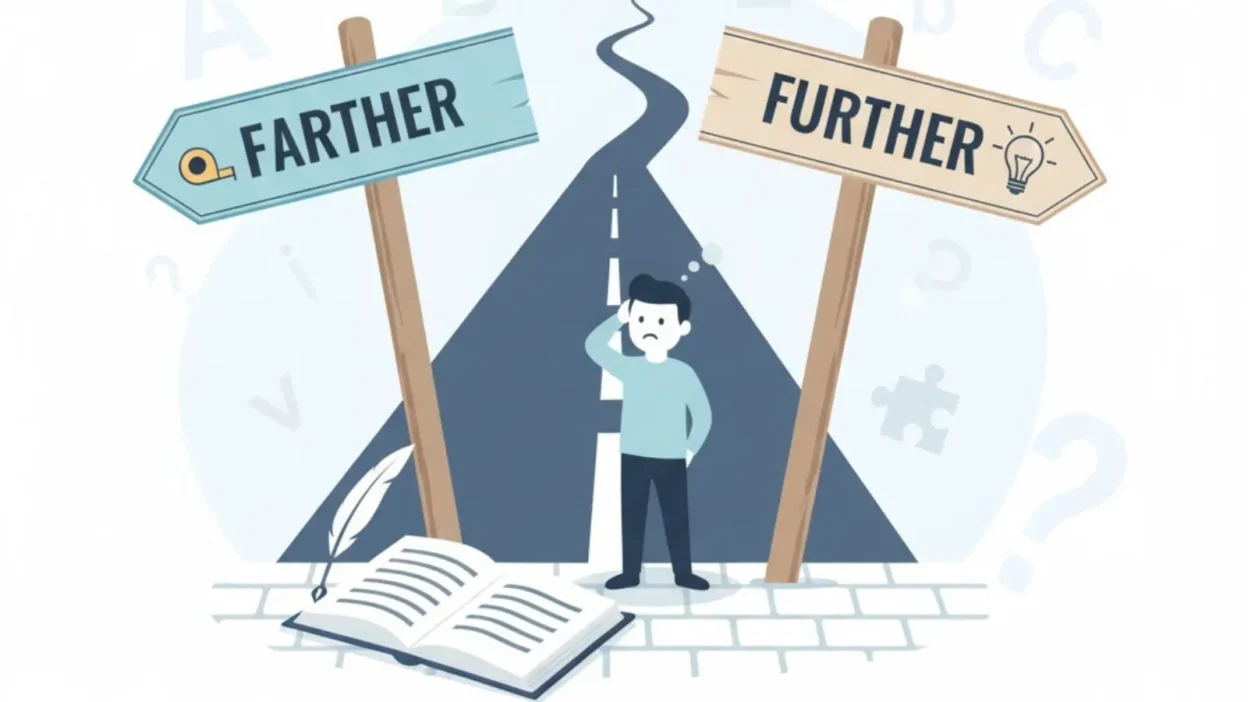
✅ “Farther” refers to physical distance — something measurable.
✅ “Further” refers to figurative or metaphorical distance — ideas, time, or progress.
Examples:
- 🏃♂️ He ran farther than his friends. (Physical distance)
- 💡 Let’s discuss this idea further. (Figurative distance)
👉 Quick tip: If you can measure it with a ruler, use farther. If it’s abstract, use further.
🕰️ The Origin of “Further” or “Farther”
Both words come from the Old English “fierðra” (further) and “feorr” (far), used to describe distance or advancement.
Over centuries, their meanings overlapped. By the 14th century, “further” became associated with advancement or continuation, while “farther” leaned toward measurable distance.
📖 In short:
- Farther evolved from “far.”
- Further evolved from “forth.”
That’s why their usage differs — one is literal, the other figurative.
🇬🇧🇺🇸 British English vs. American English Spelling
In the UK and US, both are used — but preferences differ.
| 🌐 Region | Preferred Term | Typical Usage Example |
|---|---|---|
| 🇺🇸 American English | Farther for distance, Further for degree | “He drove farther down the road.” / “Let’s go further into this issue.” |
| 🇬🇧 British English | Further for both meanings | “He walked further than expected.” |
💡 Note: In formal British writing, further is widely accepted for both cases — making it the safer global choice.
🧭 Which Spelling Should You Use?
✅ If you write for an American audience:
Use farther for physical distance, and further for abstract ideas.
✅ If you write for UK or Commonwealth readers:
Use further for both — it’s more natural and widely accepted.
✅ If you write for a global audience:
Use further — it’s the universally safe option 🌎
⚠️ Common Mistakes with “Further” or “Farther”
❌ He can’t walk further today. → ✅ He can’t walk farther today.
❌ We’ll discuss this farther tomorrow. → ✅ We’ll discuss this further tomorrow.
❌ They traveled further than 10 miles. → ✅ They traveled farther than 10 miles.
👉 Tip: Ask yourself — “Can I measure it?” If yes → use farther. If no → use further.
✍️ “Further” or “Farther” in Everyday Examples
| 💬 Context | Correct Usage | Example |
|---|---|---|
| Further | “Please contact me for further details.” | |
| 🗞️ News | Farther | “The fire spread farther into the valley.” |
| 💭 Social Media | Further | “I can’t wait to take this idea further!” |
| 🎓 Academic Writing | Further | “This research will explore the topic further.” |
| 🚶 Travel | Farther | “We drove farther than expected.” |
Both words appear naturally in modern communication — but further is far more versatile.
📊 “Further or Farther” – Google Trends & Usage Data
According to Google Trends, 🌍 “further” is searched and used much more often than “farther.”
| 📅 Year | “Further” Usage | “Farther” Usage |
|---|---|---|
| 2000 | 78% | 22% |
| 2020 | 84% | 16% |
| 2025 | 88% | 12% |
🌎 Top countries using “Further”:
UK 🇬🇧 | Australia 🇦🇺 | Canada 🇨🇦 | India 🇮🇳
🇺🇸 Top country using “Farther”:
United States
🧠 Insight: Over time, people have leaned toward using “further” for simplicity and clarity — even in physical contexts!
❓ FAQs About “Further or Farther”
Q1. Is “further” always correct?
👉 Yes, in most cases. It works for both physical and abstract uses, especially in British English.
Q2. Can “farther” mean more?
👉 Rarely. “Farther” usually refers to distance, not quantity.
Q3. What’s the difference between “go further” and “go farther”?
👉 “Go farther” = physical distance. “Go further” = progress or development.
Q4. Is “furthermore” related to “further”?
👉 Yes! It evolved from “further” meaning “in addition.”
Q5. Which is more common in writing?
👉 “Further” — it’s dominant in global English and preferred in formal writing.
Q6. Can I use “further” in American English?
👉 Absolutely! Americans use “further” for figurative meanings all the time.
Q7. How do I remember the difference easily?
👉 🔹 Farther = physical (“far”)
🔹 Further = figurative (“future”)
🌟 Conclusion
So, the “Further or Farther” debate isn’t as confusing as it seems! Both words come from similar roots, but today they play slightly different roles. 💬
Use farther when talking about real, measurable distance — like miles, steps, or length. Use further when referring to progress, time, or ideas. 🧭
If you’re writing for a global or British audience, stick with further — it’s accepted everywhere and sounds natural. For American readers, the distinction still matters, especially in formal writing.
Language evolves, and so do its rules. The best advice? Keep your writing clear, intentional, and reader-friendly — and your grammar will always go further! ✨✍️
Discover More Articles
- ✔️101+Who or Whom? The Complete Beginner Friendly Guide 2026
- 🌟 Altogether or All together What’s the Difference & When to Use Each? 2026
- ✨ Complement or Compliment What’s the Difference? ✨2026
- ⭐ Principal or Principle What’s the Difference? (Easy Guide + Examples) 2026