Every day begins with a friendly “Good morning!” — but have you ever wondered whether it should be “good morning” or “goodmorning”?
This tiny spelling question confuses thousands of English learners and even native speakers.
People often search “good morning or goodmorning” because they see both versions online and want to know which one’s right for emails, texts, and professional writing.
In this guide, we’ll clear up the confusion once and for all.
You’ll learn the correct spelling, where the other one comes from, how it’s used in British vs. American English, and which version you should use in daily life.
Simple examples, a comparison table, and real-world usage will make everything easy to remember.
✅ Good Morning or Goodmorning – Quick Answer
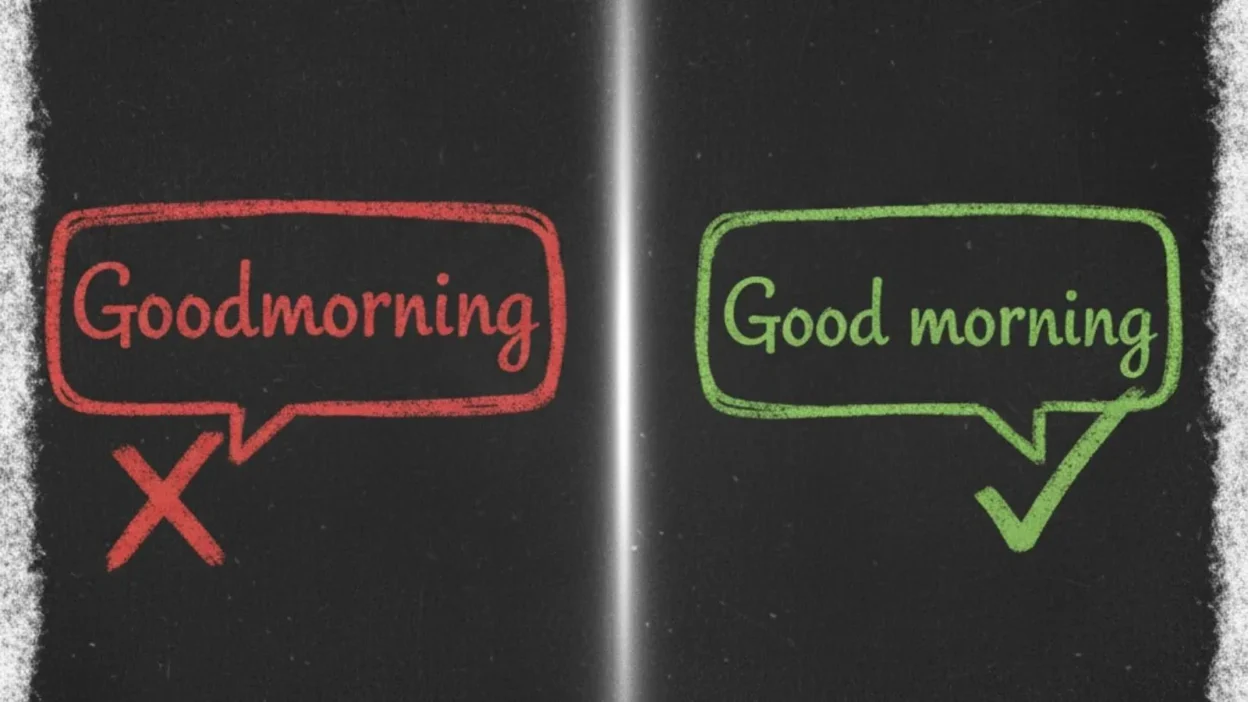
The correct spelling is “good morning” — two words.
“Goodmorning” (one word) ❌ is incorrect in standard English.
✅ Correct: Good morning, Sarah!
❌ Incorrect: Goodmorning, Sarah!
👉 “Good” is an adjective describing the noun “morning.” That’s why they are written separately.
📚 The Origin of “Good Morning”
The phrase “good morning” dates back to the early 1200s in Old English. It was a polite greeting wishing someone a pleasant start to the day.
Originally, phrases like “good night” and “good day” were also used in the same way — showing goodwill at different times of day. Over time, these greetings became a natural part of daily conversation.
“Goodmorning” as a single word never became standard because English grammar treats “good” (adjective) and “morning” (noun) as separate elements — just like “good evening” or “good afternoon.”
🇬🇧 British English vs 🇺🇸 American English Spelling
Both British and American English use “good morning” as two separate words. There’s no spelling difference between the two versions.
However, Americans tend to capitalize it less often unless it begins a sentence or appears in an email greeting.
| Context | British English | American English |
| Greeting a friend | Good morning! | Good morning! |
| Email opening | Good morning, Mr. Smith. | Good morning, Mr. Smith. |
| Hashed online tag | #GoodMorning | #GoodMorning |
✅ Both agree that “Goodmorning” (one word) is not standard.
🗣️ Which Spelling Should You Use?
Use “good morning” everywhere — formal or informal, online or offline.
- If you write for U.S. audiences: “Good morning” — always two words.
- If you write for U.K. or Commonwealth countries: Same rule applies.
- If writing globally: Stick with “Good morning” to remain correct in all English varieties.
💡 Pro tip: In hashtags, you may see #GoodMorning combined for style — but that’s social media formatting, not grammar.
⚠️ Common Mistakes with “Good Morning”
| Mistake | Correction | Why it’s wrong |
| Goodmorning everyone! | Good morning, everyone! | Should be two words |
| Have a GoodMorning! | Have a good morning! | Capitalization error |
| good morning. (no capital) | Good morning. | Always capitalize the first word of a sentence |
| Good morning John | Good morning, John | Missing comma after greeting |
Remember: “Good morning” is a phrase, not a compound word.
💬 “Good Morning” in Everyday Examples
Emails:
Good morning, Mr. Ahmed. I hope you’re doing well today.
Text messages:
Good morning! ☀️ Hope your day starts with a smile.
News or media:
The host of Good Morning America welcomed viewers to a sunny start of the week.
Formal writing:
It is always polite to greet others with “Good morning” before beginning a meeting.
Social media:
#GoodMorning everyone! Let’s make today amazing 🌸
📊 “Good Morning or Goodmorning” – Google Trends & Usage Data
According to Google Trends, searches for “good morning” are 100x higher than “goodmorning.”
| Keyword | Popularity | Correct Usage |
| good morning | ⭐⭐⭐⭐⭐ | ✅ Correct |
| goodmorning | ⭐ | ❌ Incorrect |
Top countries searching for this phrase include:
- 🇮🇳 India
- 🇵🇰 Pakistan
- 🇺🇸 United States
- 🇬🇧 United Kingdom
- 🇳🇬 Nigeria
Most users search this keyword to check email etiquette or grammar correctness.
❓ FAQs About “Good Morning or Goodmorning”
1. Is “goodmorning” one word or two?
→ Always two words: “good morning.”
2. Can I write “GoodMorning” as one word in emails?
→ No. Use two words. The one-word version is informal or incorrect.
3. Why do I see “#GoodMorning” online?
→ Hashtags often combine words, but it’s for style — not grammar.
4. Do I need a comma after “Good morning”?
→ Yes, when addressing someone: “Good morning, Sarah.”
5. Should both words be capitalized?
→ Only capitalize “Good” at the start of a sentence or greeting.
6. Is “goodmorning” used in any dialect?
→ No standard English dialect uses it officially.
7. What about “goodnight”? Why is that one word?
→ “Good night” evolved into “goodnight” over time — but “good morning” didn’t follow the same pattern.
🌅 Conclusion
So, when it comes to “Goodmorning or Good Morning,” the answer is simple: always write “good morning” — two words, just as it’s been for centuries. It’s grammatically correct, globally accepted, and perfectly polite for any situation.
Avoid the one-word version in professional writing, emails, or academic content. However, if you’re using hashtags like #GoodMorning, it’s okay — that’s a style choice, not grammar.
Next time you greet someone, you’ll know you’re spelling it right — and starting the day the correct way! 🌞
Discover More Articles
- Hippy or Hippie Which Spelling Is Correct and When to Use Each? 2026
- 101+Prefer or Perfer What Is the Correct Spelling? (2026)
- 101+Domain and Range Meaning, Rules & Simple Examples (2026)
- 101+Anyway vs Anyways What’s the Difference and Which Is Correct? 2026