If you’ve ever paused mid-sentence, wondering whether to write lay or lie, you’re not alone! 😅
This pair is one of the most confusing grammar twins in English.
People often search for “lay or lie” because both words sound similar but have totally different meanings depending on tense and context.
The confusion usually starts when we shift between present, past, and past participle forms — “lay,” “laid,” “lain,” “lying,” and “laying.” It’s enough to make even native speakers double-check their sentences!
In this article, we’ll break it all down simply: ✅ when to use lay (to put something down) and lie (to rest or recline).
You’ll see examples, tables, and even grammar trends — all explained in plain English so you never hesitate again! 💡
✨ Lay or Lie – Quick Answer
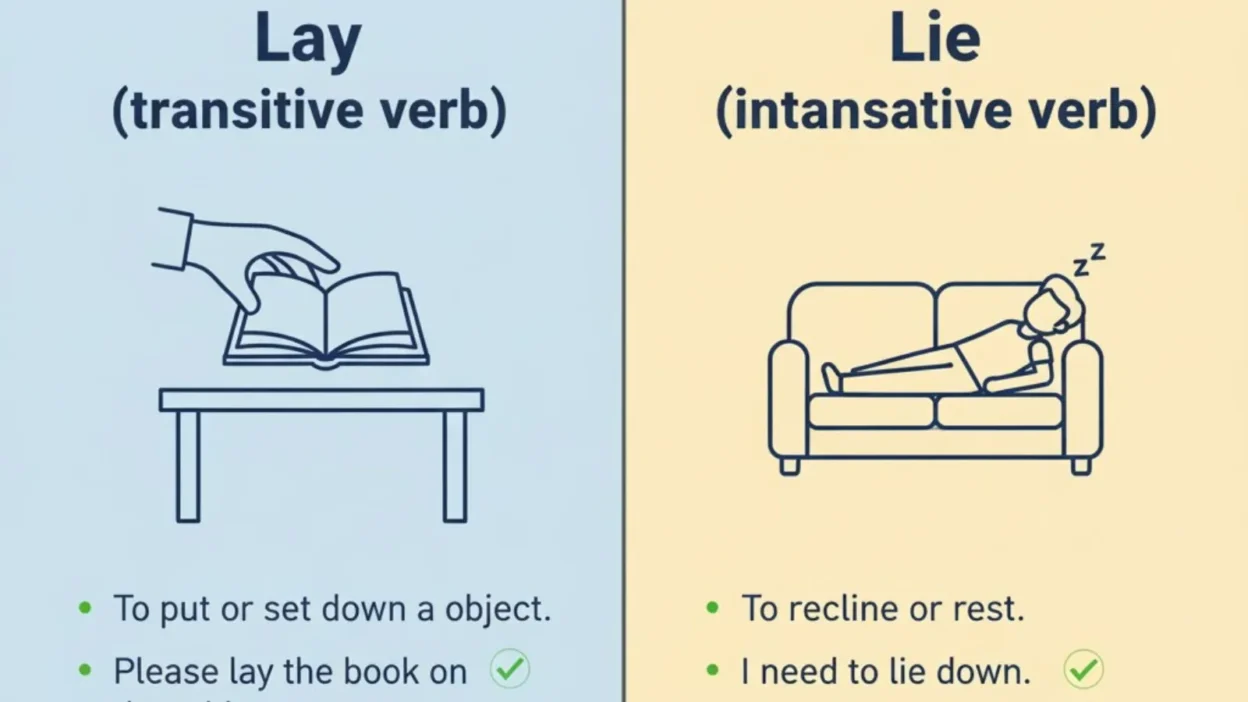
👉 Use “lay” when you place something down.
👉 Use “lie” when someone or something rests.
Examples:
- ✅ I lay the book on the table. (place something)
- ✅ I lie on the sofa after work. (rest myself)
Quick Table:
| Action | Correct Word | Example Sentence |
|---|---|---|
| To put something down | Lay | Please lay your phone on the table. |
| To recline yourself | Lie | I need to lie down after lunch. |
💡 Tip: You lay something else down, but you lie yourself down.
📚 The Origin of “Lay” and “Lie”
Both words come from Old English roots:
- Lay → from lecgan (meaning “to place or put”).
- Lie → from licgan (meaning “to recline”).
Over time, English simplified many verbs — but “lay” and “lie” kept their old forms, which overlap in confusing ways. Historically, people mixed them up so often that some grammarians began accepting certain informal uses, but traditional grammar still keeps them separate.
That’s why teachers and editors still insist: “Lay” = action, “Lie” = rest. 📝
🇺🇸🇬🇧 British English vs American English Usage
There’s little spelling difference between “lay” and “lie” across dialects — but usage trends differ slightly. Americans often mix them more in casual speech, while Brits stick closer to formal grammar rules.
| Form | British English Example | American English Example |
|---|---|---|
| Present | I lie down for a nap. | I lie down for a nap. |
| Past | I lay down yesterday. | I laid down yesterday. (common error) |
| Past Participle | I have lain here before. | I’ve laid here before. (informal US) |
⚡ Note: In formal writing, both British and American editors prefer the correct classical distinction — “lay something” and “lie down.”
🧭 Which Should You Use?
It depends on your audience and tone.
- 🏛️ Formal / Academic Writing: Always follow the rule — lay = put something down, lie = recline.
- 🗞️ Media / Everyday Writing: Native speakers may blur the line, but staying correct keeps your writing professional.
- 🌍 Global English Learners: Stick with traditional grammar rules; it helps on exams and in international communication.
✅ Safe rule:
If you can replace it with “put,” use lay.
If you can replace it with “rest,” use lie.
⚠️ Common Mistakes with “Lay” and “Lie”
Here are frequent errors people make 👇
| ❌ Wrong | ✅ Correct | Explanation |
|---|---|---|
| I’m going to lay down. | I’m going to lie down. | You’re not placing something — you’re reclining. |
| Lie the book on the shelf. | Lay the book on the shelf. | You’re placing an object. |
| I lain the keys here. | I laid the keys here. | “Laid” is the past of “lay.” |
| I laying on the bed. | I’m lying on the bed. | “Lying” is the continuous form of “lie.” |
💬 Tip: Remember the pattern — Lay / Laid / Laid vs. Lie / Lay / Lain
💬 “Lay” or “Lie” in Everyday Examples
🧾 Emails:
“Please lay the report on my desk before noon.”
📰 News:
“Residents were told to lie flat during the drill.”
💻 Social Media:
“Just gonna lie down for 10 mins… 😴”
📚 Formal Writing:
“The nation’s hopes lie in the hands of its people.”
Everyday language often bends the rules, but mastering the right usage adds polish and professionalism to your writing. 🌟
📈 “Lay” or “Lie” – Google Trends & Usage Data
According to Google Trends 📊:
- “Lay down” is searched more often globally, especially in the US, Canada, and the Philippines.
- “Lie down” dominates in the UK, Australia, and South Africa.
| Country | Most Popular Phrase | Context |
|---|---|---|
| 🇺🇸 USA | Lay down | Informal speech and lyrics |
| 🇬🇧 UK | Lie down | Formal and standard usage |
| 🇮🇳 India | Lay down | Spoken English |
| 🇦🇺 Australia | Lie down | Preferred in writing |
🎯 Insight: Even though “lay down” appears more in casual searches, “lie down” remains the grammatically correct form.
❓ FAQs – “Lay or Lie” Confusion Solved
Q1. What is the past tense of “lie”?
👉 It’s “lay.” Example: Yesterday, I lay on the couch.
Q2. What is the past tense of “lay”?
👉 It’s “laid.” Example: I laid the towel on the chair.
Q3. Is “laying down” correct?
👉 Only if you’re placing something down: I’m laying the baby in the crib.
Q4. Can I say “I laid down” instead of “I lay down”?
👉 Grammatically no, but it’s common in speech. In writing, use “I lay down.”
Q5. What’s the past participle of “lie”?
👉 It’s lain. Example: I have lain here for hours.
Q6. Why are “lay” and “lie” confusing?
👉 Because “lay” is the past of “lie”! So both share overlapping forms.
Q7. How can I remember easily?
👉 Think: “Lay it down” (object) vs. “Lie down” (yourself). 💤
🌟 Conclusion
English grammar doesn’t have to be a headache! 💪 Once you understand that “lay” always needs an object (you lay something down) and “lie” doesn’t (you lie down yourself), everything clicks.
Whether you’re writing an email, caption, or article, choosing the correct form makes your message sound polished and professional. ✍️
So next time you’re tempted to write “I’m going to lay down”, pause and remember: If you’re resting — you lie down. If you’re placing something — you lay it down. 🌿
Stay confident, write clearly, and let your grammar shine! 🌞
Discover More Articles
- 🌟 Everyday or Every day What’s the Real Difference? 2026
- ✅Passed or Past Quick Guide to Using Them Correctly 2026
- ✅ Accept or Except What’s the Real Difference? 2026
- ✅ Ensure or Insure What’s the Difference & Which Should You Use? 2026