Are you confused about when to use Login vs Log in? You’re not alone!
Many people search this phrase to understand the subtle difference between the two.
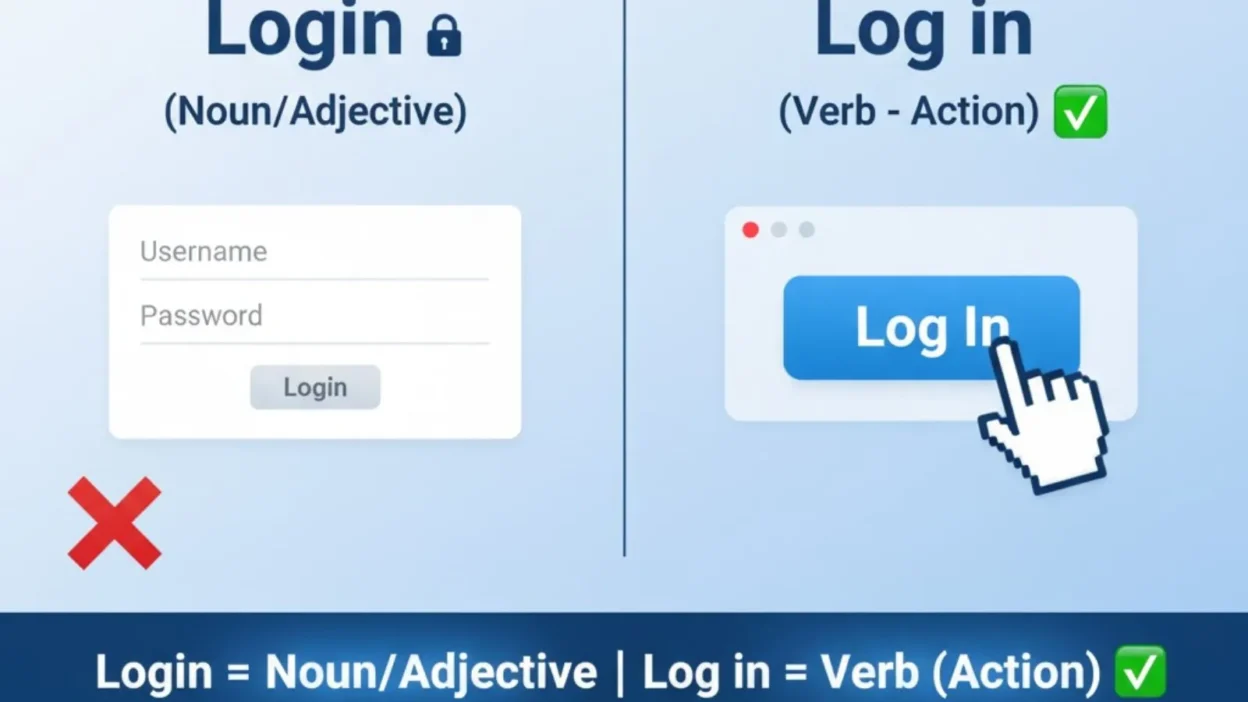
While they sound similar, “login” is usually a noun or adjective (like “your login details”), and “log in” is a verb phrase (like “please log in to your account”).
This small difference can change the meaning of your sentence, especially in emails, websites, or instructions.
Understanding this distinction is crucial for clear communication, whether you’re a student, professional, or just someone browsing online.
In this guide, we’ll break it down with examples, origin, comparisons, and expert advice to make sure you always get it right. ✅
Login or Log in – Quick Answer ⚡
- Login → Noun/Adjective: “I forgot my login details.”
- Log in → Verb: “Please log in to your account.”
💡 Tip: If you’re performing the action, use log in. If you’re talking about the username, password, or screen, use login.
The Origin of Login or Log in 📜
The term log in comes from early computing and nautical logs where users would “log” or record their entry into a system. Over time, login emerged as a shortened form to refer to credentials or the action itself in noun form.
The spelling difference exists because English tends to shorten verb phrases into nouns for convenience. Think of it like check-in at a hotel vs check in to perform the action. This is why login became standard for accounts and usernames, while log in remained the action.
Login vs Log in ⚡
Here’s the quick answer:
- Login → Noun/Adjective: “I forgot my login details.”
- Log in → Verb: “Please log in to your account.”
💡 Tip: If you’re performing the action, use log in. If you’re talking about the username, password, or screen, use login.
The Origin of Login or Log in 📜
The term log in comes from early computing and nautical logs where users would “log” or record their entry into a system. Over time, login emerged as a shortened form to refer to credentials or the action itself in noun form.
The spelling difference exists because English tends to shorten verb phrases into nouns for convenience. Think of it like check-in at a hotel vs check in to perform the action. This is why login became standard for accounts and usernames, while log in remained the action.
British English vs American English Spelling 🇬🇧🇺🇸
| Term | Usage | Region | Example |
| Login | Noun/Adj | UK & US | “Enter your login info.” |
| Log in | Verb | UK & US | “You must log in first.” |
🔹 Both spellings are the same in US and UK English, but remember:
- Log in is never used as a noun.
- Login cannot replace the action verb.
Which Should You Use? 🎯
- US users: Follow the general rule: login = noun, log in = verb.
- UK/Commonwealth users: Same rule applies, but formal documents may prefer log in in instructions.
- Global audiences: Online guides and websites almost always follow this distinction to avoid confusion.
✅ Rule of Thumb: If unsure, ask: “Am I describing an action or a thing?”
Common Mistakes with Login or Log in ❌
- ❌ “I will login now.” → Correct: “I will log in now.”
- ❌ “Enter your log in details.” → Correct: “Enter your login details.”
- ❌ Using login as a verb in documentation or emails.
💡 Always double-check if you are referring to an action or a thing.
Login or Log in in Everyday Examples ✍️
Emails:
- Correct: “Please log in to complete your registration.”
- Correct: “Your login credentials were sent to your email.”
News Articles & Social Media:
- “Users must log in to comment.”
- “Update your login info immediately for security.”
Formal Writing:
- “Access is granted after you log in using your secure login details.”
Login or Log in – Google Trends & Usage Data 📊
According to Google Trends:
- “Login” is searched slightly more often than “log in” globally.
- US & India have higher searches for login, often related to accounts and apps.
- UK & Australia maintain balanced usage between both terms.
This shows that understanding the difference is essential for tech-related searches and content creation.
Comparison Table: Login vs Log in 🔍
| Keyword | Type | Example Usage | Common Mistakes |
| Login | Noun/Adj | “Enter your login details.” | “I will login now.” |
| Log in | Verb | “Please log in to continue.” | Using as a noun |
FAQs ❓
1. Can I use login and log in interchangeably?
No, login is a noun/adjective, log in is a verb. Using them interchangeably is incorrect.
2. Is “login” more common than “log in”?
Yes, globally, login slightly outnumbers log in, especially in tech searches.
3. Can I write “login now” in emails?
No, the correct phrase is log in now.
4. Are there other variations like log-on?
Yes, log-on is less common and mainly used in software instructions.
5. Which should I use for website buttons?
Use Log in for actions and Login if referring to credentials or account page.
6. Is it correct to say “logging in”?
Yes! Logging in is the continuous action form of log in.
7. Does grammar differ between UK and US?
No, the distinction is the same; the only difference may be in formal writing preferences.
Conclusion 📝
Understanding the difference between login and log in ensures clear communication, avoids mistakes, and improves user experience. ✅ Remember:
- Login = noun/adjective (credentials, account).
- Log in = verb (the action of entering an account).
- Double-check context in emails, websites, social media, or documentation.
By following this simple rule, you can confidently write instructions, emails, and content for global audiences without confusing your readers. Clarity matters, and small distinctions like this make a big difference in professional and casual communication.
Discover More Articles
- 🌟 101+Lose or Loose What’s the Real Difference? 2026
- Setup or Set up Which One is Correct? 🤔2026
- ✨ Its or It’s What’s the Real Difference? (Simple Grammar Guide) 2026
- 🧩 Then or Than What’s the Difference? (Easy Guide with Examples) 2026