Have you ever been unsure whether to write “lose” or “loose”? 🤔 You’re not alone!
This is one of the most common spelling confusions in English. People often mix them up because they sound similar but their meanings are completely different.
Understanding the difference between lose and loose can make your writing more polished, professional, and clear.
Whether you’re writing a text, a social media post, or a formal email, using the wrong word can totally change your meaning. 😅
This article will explain the difference between lose and loose, how to remember the correct one, and when to use each with simple examples, comparison tables, and helpful grammar tips.
By the end, you’ll never mix them up again! 🌈
✅ Lose or Loose – Quick Answer
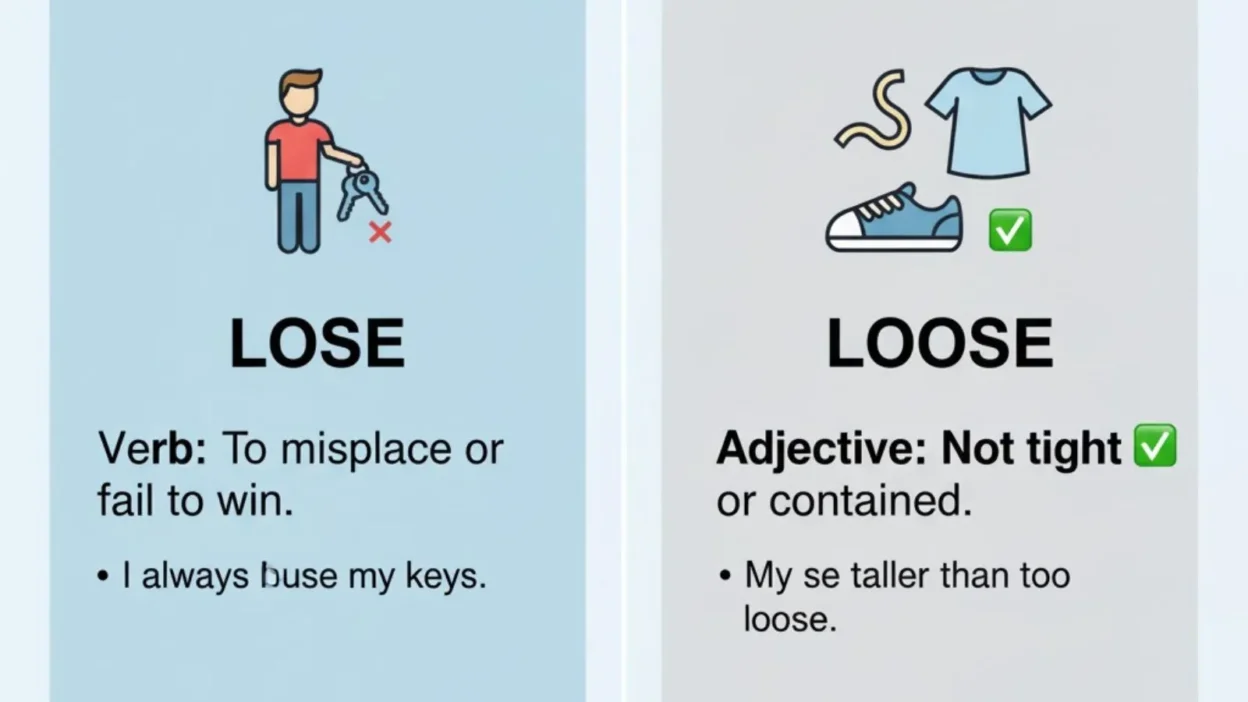
👉 Lose means to misplace, fail, or be deprived of something.
👉 Loose means not tight, free, or relaxed.
💡 Examples:
- ❌ Don’t lose your keys! (Not “loose”)
- ✅ My shirt is too loose. (Not “lose”)
- ❌ We can’t afford to loose the game. → ✅ We can’t afford to lose the game.
🧠 Quick tip: If it rhymes with choose, it’s loose. If it rhymes with booze, it’s lose!
📜 The Origin of Lose and Loose
Both words come from Old English but have evolved differently:
- Lose came from losian (meaning “to perish or be lost”).
- Loose came from lōs (meaning “free, not tight”).
Over time, their spelling and pronunciation became similar — which explains why so many people confuse them! 🕰️
While lose focuses on failure or loss, loose refers to freedom or looseness. Their historical roots explain why they sound close but mean very different things.
🇬🇧🇺🇸 British English vs American English Spelling
Both British and American English use lose and loose the same way — no regional difference here! 🙌
However, confusion arises because some people overcorrect or assume “loose” is the fancy or British spelling of “lose” — it’s not.
📊 Comparison Table:
| Word | Meaning | Example | Type | Common Error |
|---|---|---|---|---|
| Lose | To misplace or fail | Don’t lose hope. | Verb | “Loose” used instead |
| Loose | Not tight, free | My shoe is loose. | Adjective | “Lose” used instead |
✅ Same rule applies worldwide!
🌍 Which Spelling Should You Use?
- ✳️ In the US: Always use lose (verb) and loose (adjective).
- ✳️ In the UK and Commonwealth countries: The same rule applies!
- ✳️ Globally: English learners should memorize that lose = failure/misplace and loose = not tight.
💬 Example:
“Don’t lose your passport — it’s in your loose jacket pocket!”
🚫 Common Mistakes with Lose and Loose
Here are the most frequent mix-ups you’ll see online:
| Wrong | Correct | Explanation |
|---|---|---|
| Don’t loose hope. | Don’t lose hope. | You’re not freeing hope; you’re misplacing it. |
| My jeans are lose. | My jeans are loose. | Clothing is not tight, not lost! |
| We might loose the match. | We might lose the match. | You lose games, not loosen them. |
🔥 Tip: Remember — “Loose” has double ‘o’ like an open loop — it’s not tight!
✍️ Lose or Loose in Everyday Examples
| Context | Example | Correct Word |
|---|---|---|
| “We can’t afford to lose this client.” | Lose | |
| 📰 News | “The government may lose support.” | Lose |
| 📱 Social Media | “My bracelet is too loose!” | Loose |
| 🏫 Formal Writing | “She didn’t want to lose focus.” | Lose |
| 💬 Informal | “These pants feel loose.” | Loose |
🪶 Pro tip: In writing, double-check your verbs. If you’re doing something (action), it’s usually lose!
📈 Lose or Loose – Google Trends & Usage Data
According to Google Trends, searches for “lose or loose” peak around exam seasons and grammar quizzes 📊.
- 🌎 Top countries searching: United States, India, Philippines, and the UK.
- 💡 Most people search this to confirm which word to use in “lose weight” — remember, it’s lose weight, not loose weight!
| Phrase | Correct Form | Monthly Search Volume |
|---|---|---|
| Lose weight | ✅ Correct | Very High |
| Loose weight | ❌ Incorrect | Very High (mistaken use) |
❓ FAQs About Lose vs Loose
1️⃣ What’s the main difference between “lose” and “loose”?
➡️ Lose means to misplace or not win; loose means not tight or free.
2️⃣ Is “loose” ever a verb?
➡️ Rarely! As a verb, it means “to release” (e.g., loose the dogs!).
3️⃣ Why do people write “loose weight”?
➡️ It’s a spelling mistake. The correct phrase is lose weight.
4️⃣ Can you “loose” something in grammar?
➡️ No — unless you’re using it poetically to mean “set free.”
5️⃣ How to remember the difference easily?
➡️ Lose has one ‘o’ like “gone.” Loose has two ‘o’s — it’s open and not tight!
6️⃣ Is “lose” pronounced like “choose”?
➡️ No! Lose rhymes with “booze,” while loose rhymes with “moose.”
7️⃣ Which one to use in “don’t lose your cool”?
➡️ It’s lose — because you’re not freeing your cool, you’re misplacing it. 😄
💬 Conclusion
In short, “lose” and “loose” might look alike, but they serve totally different purposes. 🧠
- Lose = fail, misplace, or suffer a loss.
- Loose = free, not tight, or relaxed.
Whenever you’re unsure, think:
👉 If it’s about not having something, use lose.
👉 If it’s about something being not tight, use loose.
By mastering this simple rule, your grammar will sound clearer and more professional. So, next time you write — don’t lose your confidence or your loose grammar sense! ✨
Discover More Articles
- 🧩 Then or Than What’s the Difference? (Easy Guide with Examples) 2026
- ✨ Its or It’s What’s the Real Difference? (Simple Grammar Guide) 2026
- Login or Log in What’s the Difference? 🤔💻 2026
- Setup or Set up Which One is Correct? 🤔2026