People often get stuck choosing between “maybe” and “may be”, and it’s not just a tiny spelling issue—it’s a grammar puzzle.
Why? Because both phrases sound exactly the same when spoken, but they play very different roles in writing.
Many learners and even native speakers search for “Maybe or may be” to clarify which one is correct in a sentence.
This confusion can lead to awkward or incorrect writing in emails, essays, or social media posts.
In this article, we’ll unravel the mystery, explain the difference simply, and show you when to use each form confidently.
Whether you’re writing for school, work, or casual chatting, by the end you’ll know exactly when to use “maybe” vs “may be” and sound polished, smart, and mistake-free.
Maybe or May be – Quick Answer
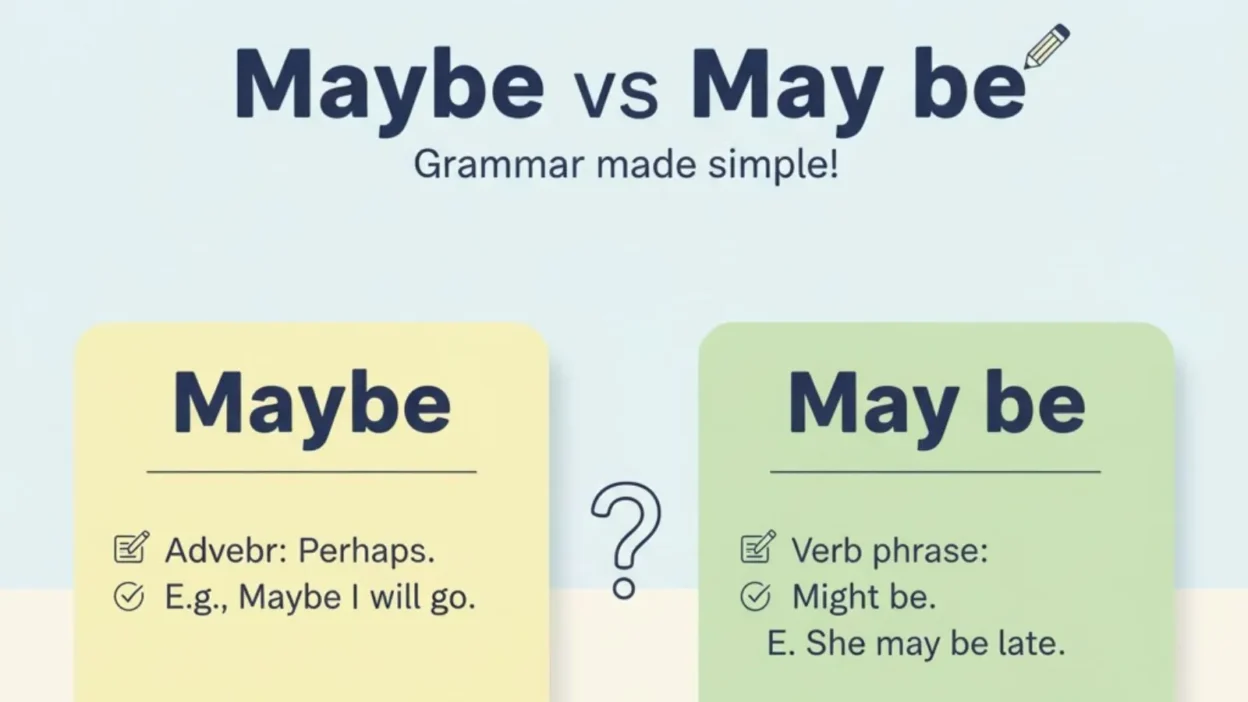
Maybe (one word) = an adverb, meaning “perhaps” or “possibly.”
- Example: Maybe I’ll join you later.
May be (two words) = modal verb “may” + “be,” expressing possibility of existence or state.
- Example: She may be tired after the trip.
A simple trick: if you can replace the phrase with “perhaps” or “possibly,” use maybe. If you can swap it out for “might be,” then may be is your friend. Dictionary.com+2Chegg+2
The Origin of Maybe or May be
The phrase maybe comes historically from squishing together may + be. Dictionary.com+1 Over time, it evolved into a single adverb in English to express uncertainty (like “perhaps”). On the other hand, may be remains two separate words: “may” works as a modal verb (indicating possibility) and “be” is the base form of the verb to be. Cambridge Dictionary+1 Because of this shared origin, they are related — but their grammatical roles diverged, which is why the distinction matters today.
British English vs American English Spelling
Here’s a look at how “maybe” and “may be” work (or don’t change) across British and American English:
| Form | British English | American English |
|---|---|---|
| maybe (one word) | ✓ Used the same way | ✓ Identical usage |
| may be (two words) | ✓ Same structure | ✓ Same structure |
Conclusion: There is no difference in the spelling of “maybe” vs “may be” between British and American English. Both varieties treat the words the same. Cambridge Dictionary+1
Which Spelling Should You Use?
- If you’re writing in the US or UK/Commonwealth, use whichever form fits your meaning: “maybe” when you mean “perhaps,” and “may be” when talking about possibility of being.
- For global or non-native English audiences, focus less on regional spelling (they’re the same) and more on correct grammar: choose based on meaning, not locale.
- In formal writing, clarity is key: if you’re unsure, try substituting with “perhaps” (for maybe) or “might be” (for may be) to check what makes sense.
Common Mistakes with Maybe or May be
Here are some typical errors and corrections:
- Mistake: There maybe a problem.
Correction: There may be a problem. (“may be” = possible existence) - Mistake: Maybe he is right. (used as noun)
Correction: That’s okay actually — “maybe” can function as a noun informally: It’s a maybe. Chegg - Mistake: I might be late, maybe. (used redundantly)
Better: Maybe I’ll be late. or I may be late. - Mistake: He maybe the winner.
Correction: He may be the winner. (because “may be” expresses possibility)
Maybe or May be in Everyday Examples
Here are some real-life contexts and how to use both:
- In Emails:
Maybe we can reschedule the meeting for Monday.
Our client may be available next week. - In News Articles:
Maybe the stock market will recover soon.
There may be a rise in interest rates next quarter. - On Social Media:
“Maybe I’ll go to the concert 🎶”
“He may be moving to a new city soon!” - In Formal Writing:
Maybe further research is needed before we draw conclusions.
There may be significant implications for global policy.
Maybe or May be – Google Trends & Usage Data
While exact numbers vary, “maybe or may be” is a very common query among English learners. On Google Trends, searches for “maybe vs may be” and similar phrases show consistent interest across English-speaking countries, including the US, UK, India, and Pakistan (where English is a common second language). This reflects how frequent the confusion is in both learning and everyday writing contexts.
Even though both forms sound the same, non-native speakers and students especially search for the difference to improve clarity and correctness. Because it’s such a basic grammar point, it remains popular year-round.
Keyword Variations Comparison Table
Here are related keyword variations side by side to help you understand their nuance:
| Variation | Meaning | Usage Notes |
|---|---|---|
| maybe | perhaps, possibly | One-word adverb expressing uncertainty. |
| may be | might be, could be | Two-word verb phrase (modal + base verb). |
| might be | maybe, could be | Alternative to “may be”; slightly more tentative. |
FAQs (Frequently Asked Questions)
1. Is “maybe” always correct instead of “may be”?
No — you choose based on meaning. Use “maybe” when you mean “perhaps.” Use “may be” when you mean “might be” (existence or state).
2. Can I use “may be” in past tense?
Generally, “may be” is used for present or future possibilities. For past, people often use “might have been” or “may have been.” Keep English Up
3. Is “maybe” informal?
Yes, “maybe” is more common in spoken and informal writing. For very formal writing, “perhaps” is often preferred. Aprende Inglés en Leganés+1
4. Can “maybe” be used as a noun?
Yes, informally, “a maybe” can mean an uncertain answer (“She said yes, but it might still be a maybe.”). Chegg
5. How do I test which to use?
Try to replace the word(s) with “perhaps/possibly” or “might be”: whichever substitution makes sense indicates the correct form. Dictionary.com
6. Is there a pronunciation difference?
Yes — when spoken, maybe (one word) is often smoother, while in may be the stress can fall on “may” and “be” may sound more separate. TIIAME Staff
7. Can “may be” be replaced with “might be”?
Often yes — “may be” and “might be” are similar in meaning (expressing possibility). But “might be” is more common for very uncertain or hypothetical statements. Chegg
Conclusion
In short: “maybe” (one word) and “may be” (two words) sound the same but mean different things. “Maybe” is an adverb expressing possibility — like “perhaps.” “May be” is a modal verb plus “be” and points to something being possible or likely. There’s no difference in spelling between British and American English — just meaning matters.
When you write, always check the context. Can you replace it with “perhaps” or “might be”? That little test will guide you. Use “maybe” for uncertainty, and “may be” when talking about a potential state or condition. With that clarity, your writing — whether formal or casual — will be sharper, clearer, and free of this common mistake.
Discover More Articles
- 🤝 Each Other or One Another? The Complete Guide to Correct Usage 2026
- 🌟 Among or Between Meaning, Usage & Simple Guide 🌟 2026
- 🌟 Since or Because What’s the Difference & Which One Should You Use? 2026
- 🌟 Few or A Few What’s the Difference? A Simple Guide to Clear English Usage 🌟 2026