Have you ever paused while typing and wondered, “Is it Noone or No one?” 🤔 You’re not alone!
This little confusion has puzzled students, writers, and even professionals for years.
It’s one of those sneaky grammar details that often slips through spell check — yet can make your writing look either polished or incorrect.
People search for “Noone or No one” because both look right at first glance.
The word “Noone” seems natural — after all, we have “someone” and “anyone,” right? But English doesn’t always follow one pattern! 😅
In this guide, we’ll clear up the confusion once and for all. You’ll learn the correct spelling, how it developed, what style guides say, and how it’s used differently in British vs. American English.
Plus, we’ll share real-world examples and a quick comparison table to help you remember the difference forever.
✅ Noone or No One – Quick Answer
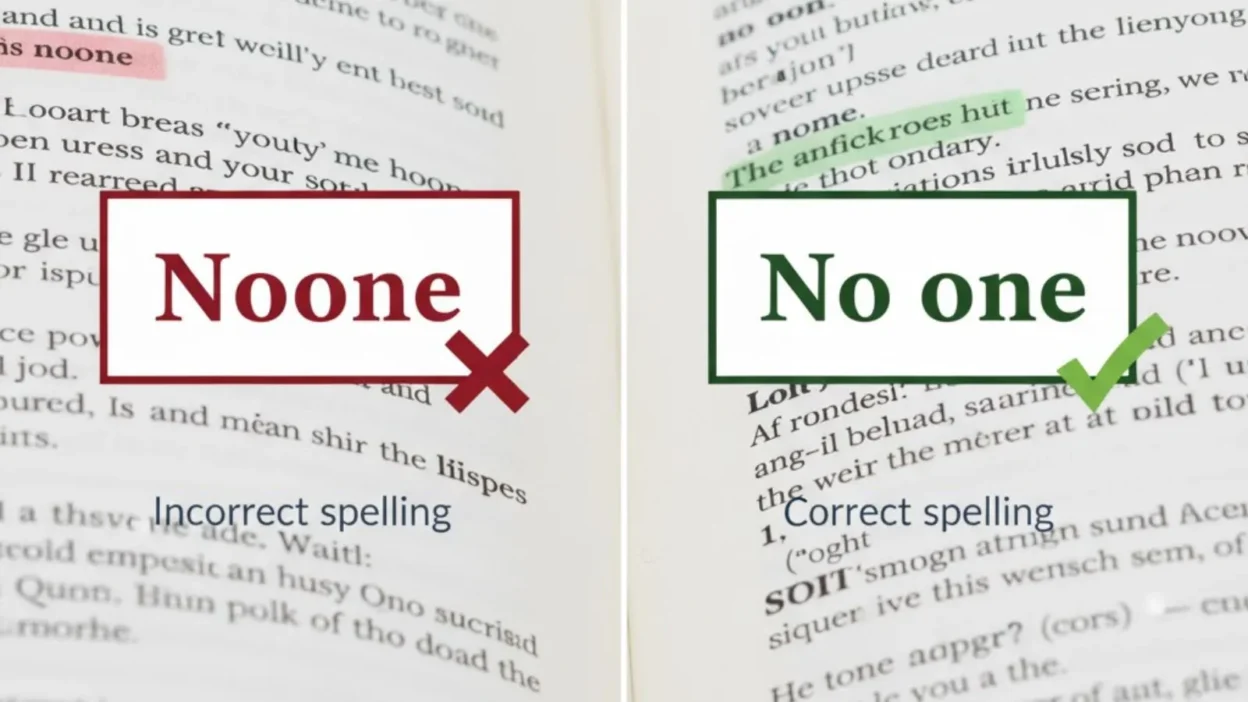
👉 The correct spelling is “No one.”
The word “Noone” ❌ is incorrect in standard English.
✅ Examples:
- ✔️ There was no one at the office today.
- ✔️ No one knew the answer to the question.
- ❌ Noone knew the answer. (Incorrect)
Tip: Remember — “No one” is like “not anyone.”
✅ Noone vs No One – Quick Answer
👉 The correct spelling is “No one.”
The word “Noone” ❌ is incorrect and not used in standard English writing.
✅ Examples:
- ✔️ No one was home when I arrived.
- ✔️ No one knew the answer.
- ❌ Noone was home when I arrived. (Incorrect)
💡 Tip: Think of “No one” as meaning “Not anyone.”
📜 The Origin of “No One”
The phrase “no one” comes from Old English, where it literally meant “not a single person.” Over time, other compound pronouns like someone and anyone were formed — but “no one” didn’t merge the same way.
Why not? Because “noone” could be misread as “Noon” (midday) 🌞. To avoid confusion, writers continued separating the two words. Dictionaries like Oxford and Merriam-Webster list only “no one” as correct.
So, the split spelling stayed — even as the language evolved.
🇬🇧🇺🇸 British English vs. American English Spelling
In both British and American English, the correct form is “no one.”
However, the confusion persists because other pronouns (someone, everyone, anyone) are single words.
Here’s a quick comparison 👇
| Pronoun Type | British English 🇬🇧 | American English 🇺🇸 | Correct Form |
| No one / Noone | No one | No one | ✅ No one |
| Someone | Someone | Someone | ✅ Someone |
| Anyone | Anyone | Anyone | ✅ Anyone |
| Everyone | Everyone | Everyone | ✅ Everyone |
📝 Rule of thumb: “No one” always stays two words — everywhere!
🧭 Which Spelling Should You Use?
If you’re writing for any professional, academic, or global audience, always use “no one.” 🌍
- US readers: “No one” ✅
- UK/Commonwealth readers: “No one” ✅
- Online/global writing: “No one” ✅
The form “Noone” might appear casually on social media, but it’s not accepted in formal writing, journalism, or publishing.
👉 Stick with “No one” to look confident and grammatically correct.
⚠️ Common Mistakes with “No One”
Here are some frequent mix-ups people make (and how to fix them):
| ❌ Wrong | ✅ Correct | 💬 Why |
| Noone cares. | No one cares. | “Noone” is not a word. |
| Noone was there. | No one was there. | Keep them separate. |
| There’s no-one here. | There’s no one here. | Hyphen is unnecessary. |
💡 Tip: Never hyphenate or merge “no” and “one.”
✍️ “No One” in Everyday Examples
Let’s look at how “no one” appears in real life:
📧 In Emails:
“Unfortunately, no one responded to the meeting invite.”
📰 In News Headlines:
“No one was injured during the storm, officials confirm.”
💬 On Social Media:
“No one: Absolutely no one. Me at 2 a.m.: Cleaning the kitchen.” 😂
🏫 In Formal Writing:
“No one can predict the future with certainty.”
These examples show it fits perfectly in both formal and informal writing.
📈 “No One” – Google Trends & Usage Data
According to Google Trends, searches for “Noone or No one” are popular in the US, UK, India, and Australia — especially among students and writers.
Here’s what data shows:
| Region 🌍 | Preferred Form | Popularity 🔥 |
| United States 🇺🇸 | No one | ⭐⭐⭐⭐ |
| United Kingdom 🇬🇧 | No one | ⭐⭐⭐⭐ |
| Australia 🇦🇺 | No one | ⭐⭐⭐ |
| India 🇮🇳 | No one | ⭐⭐⭐⭐ |
| Canada 🇨🇦 | No one | ⭐⭐⭐⭐ |
📊 Result: “No one” dominates worldwide. “Noone” is only a common typo.
❓ FAQs about “Noone or No One”
Q1. Is “Noone” ever correct?
➡️ No, “Noone” is always incorrect in modern English.
Q2. Why do people use “Noone”?
➡️ Because it looks similar to words like “someone” and “anyone,” but it’s a mistake.
Q3. Can I use “No-one”?
➡️ Not recommended — it’s an outdated British form. Use “No one” instead.
Q4. Does “No one” mean the same as “Nobody”?
➡️ Yes, though “Nobody” sounds slightly more casual.
Q5. What part of speech is “No one”?
➡️ It’s an indefinite pronoun — referring to “not any person.”
Q6. Can I start a sentence with “No one”?
➡️ Yes! Example: “No one knows the truth.”
Q7. How to remember the correct spelling?
➡️ Think: “There’s no space? No one will like that!” 😄
🏁 Conclusion
So, the mystery of “Noone or No one” is solved! ✅
The correct, accepted, and professional form is “No one.”
It may seem like a small detail, but choosing the right spelling keeps your writing polished and credible. Whether you’re sending an email, writing an essay, or posting online — remember: No one (two words) is always right.
Keep it simple, smart, and grammatically correct every time! 💪✨
Discover More Articles
- Everytime or Every time Which One is Correct? 🤔 2026
- ✅ Anymore or Any more What’s the Correct Spelling? 2026
- 101 + Alright or All right Which One Is Correct? 🤔✍️ 2026
- 101 + Email or E-mail Which One is Correct? 📧 2026