Many people search for “Since or Because” because these two small words cause big confusion. 🤯
Both can introduce reasons, both appear in daily writing, and both seem correct in many sentences.
Yet teachers, editors, and grammar guides often treat them differently so writers get stuck wondering: Which one should I choose?
This article clears that confusion. ✨
You’ll learn the quick answer, how the words originated, when they differ, and which version works best in emails, academic writing, social media, and professional communication.
You’ll also see how British vs American English treats them, along with real world examples and usage trends.
By the end, you will know exactly when to use “since” and when “because” is the better choice without overthinking. ✔️
Let’s make your writing clearer, sharper, and more confident. 🚀
⚡ Since or Because Quick Answer
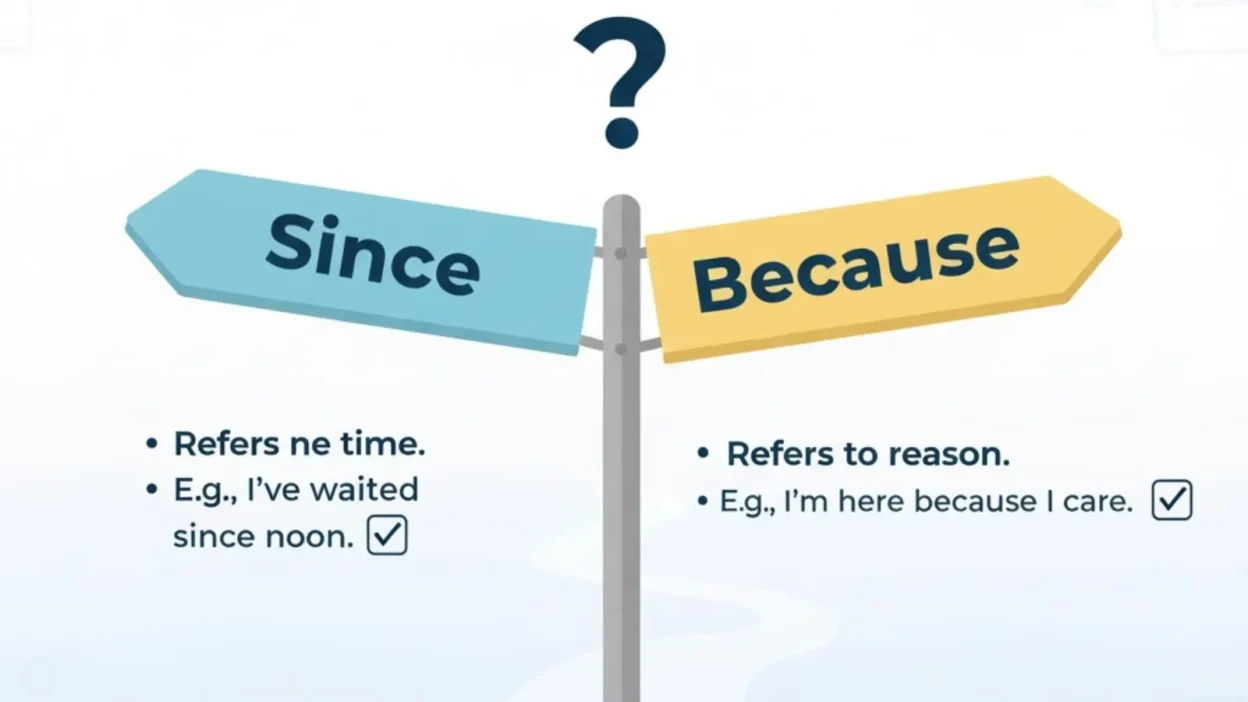
Use because to show a clear reason.
Use since to show either time or a reason—but it is best for time in formal writing.
✅ Examples:
- Reason: “I stayed home because it was raining.”
- Time: “I’ve lived here since 2010.”
- Possible but sometimes unclear: “I stayed home since it was raining.” (Reason, but can sound like time)
👉 Best rule:
Use because for reasons.
Use since for time.
📜 The Origin of “Since” and “Because”
- Since comes from Old English sithen, meaning “after that time.”
- Because comes from Middle English bi cause, meaning “by cause” or “for the reason that.”
Originally, since only meant time, but over centuries it also gained a second meaning: reason.
Because has always been the clearer choice for showing cause.
👉 That’s why confusion exists today—since has two roles, and because has one strong role.
🇬🇧 British English vs 🇺🇸 American English Usage
Both dialects use since and because, but the style rules differ slightly.
🇺🇸 American English
- Prefers because for clarity.
- Treats since (reason) as informal or ambiguous.
🇬🇧 British English
- Uses since for reason more often.
- Accepts both forms in most writing styles.
📊 Comparison Table
| Usage Area | Since (Reason) | Because (Reason) | Since (Time) |
|---|---|---|---|
| American English | Less common | ✔️ Preferred | ✔️ Standard |
| British English | ✔️ Common | ✔️ Standard | ✔️ Standard |
| Formal Writing | Avoid | ✔️ Strong choice | Only for time |
| Casual/Social | ✔️ Fine | ✔️ Fine | ✔️ Standard |
🎯 Which Spelling Should You Use?
✔️ If writing for US audiences
Use because for reasons.
Use since only for time.
✔️ If writing for UK/Commonwealth audiences
Both are acceptable, but because is clearer.
✔️ If writing for a global audience
Use because for reasons.
It avoids confusion everywhere.
❗ Common Mistakes with “Since” or “Because”
❌ Mistake 1: Using since when time and reason are both possible
- “Since he left, she was sad.” (Time or reason?)
✅ Fix: “She was sad because he left.”
❌ Mistake 2: Using because when showing time
- “Because Monday, I was busy.”
❌ Incorrect
✅ Fix: “Since Monday, I’ve been busy.”
❌ Mistake 3: Overusing “since” in formal writing
Keep it to time-based use only.
📝 “Since or Because” in Everyday Examples
📧 Emails
- “I’m late because I had a meeting.”
- “I’ve handled this task since last week.”
📰 News
- “Sales fell because demand dropped.”
- “Markets have grown since 2020.”
📱 Social Media
- “I’m smiling because today was amazing! 😄”
- “Haven’t seen him since college.”
🎓 Formal Writing
- Prefer because for all reasons.
- Use since only for time references.
🌍 “Since or Because” – Google Trends & Usage Data
- “Because” is searched more globally because users want clarity in writing.
- “Since” spikes in searches in countries with British influence (UK, India, Pakistan, Australia).
- Searches peak during academic seasons as students ask:
“Is ‘since’ formal?”
“Can I use ‘since’ to show reason?”
📊 Keyword Variations Table
| Keyword Variation | Meaning | Popularity |
|---|---|---|
| Since or because | General confusion | ⭐⭐⭐⭐⭐ |
| Since vs because | Comparison | ⭐⭐⭐⭐ |
| When to use since | Time-related | ⭐⭐⭐ |
| Because vs since grammar | Grammar-focused | ⭐⭐⭐⭐⭐ |
❓ FAQs – Since or Because
1. Is “since” formal?
For time, yes.
For reason, it is less formal.
2. Can “since” mean “because”?
Yes, but it may create confusion.
3. Is “because” always correct?
For reasons—yes.
4. Can I start a sentence with “because”?
Yes. Modern grammar accepts it.
5. Which one is better for IELTS?
Use because for clarity.
Use since only for time.
6. Is “since” past or present?
It connects a starting point to now.
7. Why do teachers avoid “since (reason)” in essays?
Because it can sound unclear or informal.
🏁 Conclusion
Choosing between “since” and “because” becomes simple when you know their roles. Because gives a clear reason every time. It removes confusion and works well in academic, business, and global communication. Since, however, has two meanings—time and reason—which often leads to unclear sentences. That’s why experts recommend using it mainly for time in professional writing.
In British English, both words are flexible, but clarity still wins. In American English, because is always the safer option when giving a reason. Across emails, reports, essays, or social media, choosing the right word helps your message stay sharp and easy to understand.
If you want to improve your writing and avoid mistakes, follow this simple rule:
👉 Use because for reasons.
👉 Use since for time.
With this guide, you now know when to use each word with confidence. ✨✍️
Discover More Articles
- 🤝 Each Other or One Another? The Complete Guide to Correct Usage 2026
- Maybe or May be What’s the Right Choice? 😕 2026
- 🌟 Among or Between Meaning, Usage & Simple Guide 🌟 2026
- 🌟 Few or A Few What’s the Difference? A Simple Guide to Clear English Usage 🌟 2026