Have you ever paused while writing and wondered, “Should I use then or than?” 🤔 You’re not alone!
This is one of the most common grammar confusions in English. Both words look and sound similar, but their meanings are very different.
Understanding the correct use of “then” and “than” helps you write with confidence — whether it’s a school essay, work email, or social media caption.
In this quick and clear guide, you’ll learn:
✅ The difference between then and than
✅ How to use them correctly in sentences
✅ Common mistakes (and how to fix them)
✅ Usage patterns in American vs. British English
By the end, you’ll never mix up then and than again! 🚀
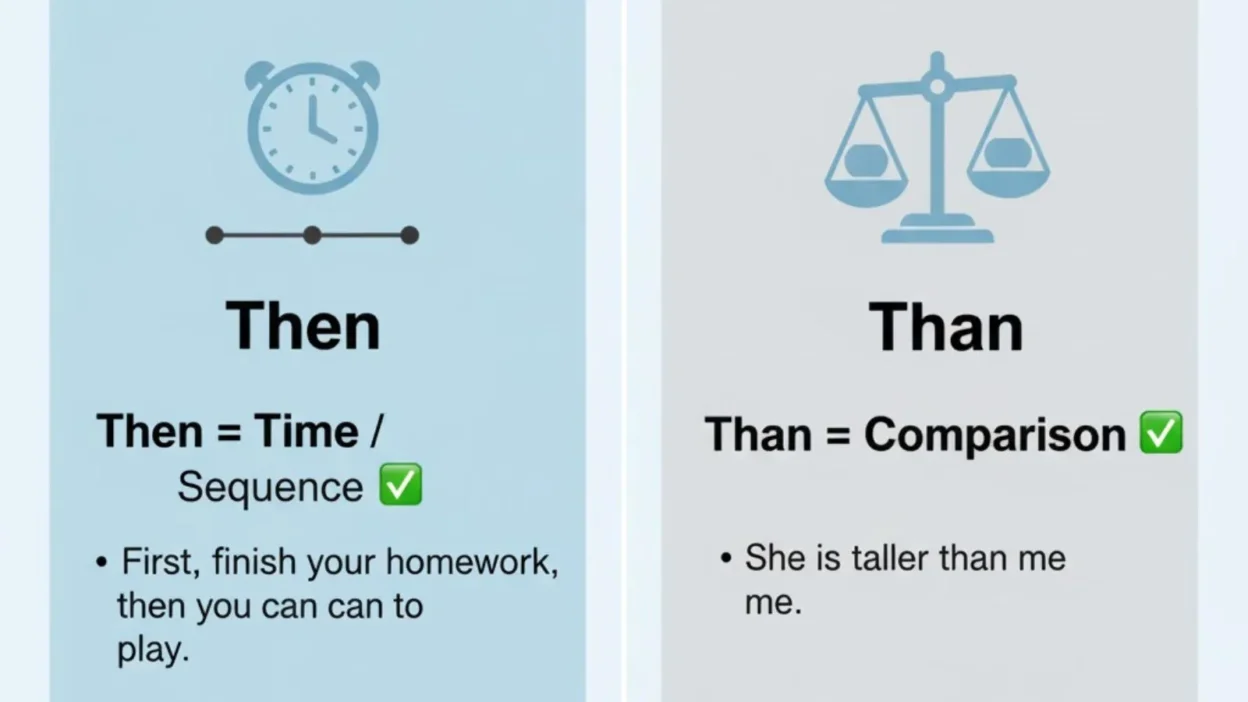
💡 Then or Than — Quick Answer
👉 Then refers to time — what happens next or after that.
👉 Than is used for comparison — to show a difference between two things.
Examples:
- I’ll call you then. (time)
- She is taller than me. (comparison)
✅ Tip: If you can replace the word with “next” → use then.
If you’re comparing → use than.
💡 Then vs Than – Quick Answer
👉 Then = Time or sequence (What happens next).
👉 Than = Comparison (Shows difference between two things).
Examples:
- I’ll see you then. ✅ (Time)
- She is smarter than me. ✅ (Comparison)
🧠 Easy trick:
If you can replace it with “next,” use then.
If it’s comparing, use than.
📜 The Origin of Then and Than
The confusion between then and than dates back to Old English.
- Then comes from the Old English þanne or þænne, meaning “at that time.”
- Than evolved from þanne too — originally, both were the same word! 😮
Over centuries, their meanings separated:
- Then took the time meaning.
- Than took the comparison meaning.
That’s why even today, people still mix them up — they were once twins! 👯♂️
🇬🇧🇺🇸 British English vs. American English Spelling
Good news — both then and than are spelled the same in British and American English.
The difference lies in usage frequency and context, not spelling.
| 🇺🇸 American English | 🇬🇧 British English | Example Sentence |
|---|---|---|
| Then ✅ | Then ✅ | Let’s go out then. |
| Than ✅ | Than ✅ | She’s faster than her brother. |
| (no difference) | (no difference) | Both forms are identical in spelling and meaning. |
✅ Verdict: There’s no regional difference — just be clear on meaning!
🎯 Which Should You Use?
It depends on what you want to say:
- ✳️ Use then for time → sequencing events or results. Example: Finish your homework, then you can play.
- ✳️ Use than for comparisons → showing differences. Example: This book is better than that one.
📌 Advice by Audience:
| Audience | Recommended Usage | Example |
|---|---|---|
| US Writers | Use standard grammar rules | He’s smarter than her. |
| UK/Commonwealth | Same rules apply | We’ll meet then. |
| Global/Business English | Avoid confusion: proofread for correct word | “If not now, then when?” |
🚫 Common Mistakes with Then and Than
Here are some frequent mix-ups 👇
| ❌ Wrong | ✅ Correct | Explanation |
|---|---|---|
| I’m better then you. | I’m better than you. | Comparison → use than |
| We went home, than watched TV. | We went home, then watched TV. | Sequence of time → use then |
| She’s older then me. | She’s older than me. | Comparison → use than |
| If you’re free than, come over. | If you’re free then, come over. | Refers to time → use then |
👉 Tip: Say the sentence aloud. If it sounds like “next”, use then. If it compares, use than.
📝 Then or Than in Everyday Examples
Let’s see how both appear in real life:
| Context | Example Sentence |
|---|---|
| “Please submit the report, then join the meeting.” | |
| 📰 News | “Prices are now higher than last year.” |
| 💬 Social Media | “Back then, life was simpler 😊.” |
| 🎓 Academic Writing | “It is better to plan than to regret later.” |
| 💌 Personal Note | “Let’s meet for coffee, then decide.” |
✅ Rule of thumb:
Use then for order and time.
Use than for comparison.
📊 Then or Than — Google Trends & Usage Data
According to Google Trends, searches for “then or than” spike in:
🌎 The United States, India, the UK, and the Philippines — where English learners often double-check grammar usage.
| Country | Search Interest (%) | Common Query |
|---|---|---|
| 🇺🇸 USA | 100% | “Then or than difference” |
| 🇮🇳 India | 83% | “When to use then vs than” |
| 🇬🇧 UK | 74% | “Then or than grammar” |
| 🇵🇭 Philippines | 69% | “Than vs then examples” |
🧠 Fun fact: Then is about 6x more common online than than, because it’s used in storytelling and sequencing!
❓ FAQs – Then vs Than
Q1. What is the main difference between then and than?
👉 Then = time; Than = comparison.
Q2. Can I use then and than interchangeably?
❌ No! They change the meaning completely.
Q3. Which one is used in “better than”?
✅ Always than.
Q4. Which one is used in “if…then” statements?
✅ Always then.
Q5. Is “rather then” correct?
❌ No, it should be rather than.
Q6. Can “then” mean “in that case”?
✅ Yes. Example: “If you’re ready, then let’s go.”
Q7. How can I remember the difference easily?
🔑 Than = Comparison, Then = Time.
🏁 Conclusion
In summary, “then” and “than” may look alike, but their meanings are worlds apart 🌍.
Use then when you’re talking about time or sequence, and than when you’re comparing things.
Practicing simple sentences like:
- “First eat, then play.”
- “I’d rather read than watch TV.”
…will help you remember effortlessly!
So next time you write an email, caption, or message, you’ll know exactly which word to use — and impress with perfect grammar every time. 🌟
Discover More Articles
- 🌟 101+Lose or Loose What’s the Real Difference? 2026
- Setup or Set up Which One is Correct? 🤔2026
- Login or Log in What’s the Difference? 🤔💻 2026
- ✨ Its or It’s What’s the Real Difference? (Simple Grammar Guide) 2026