Many English learners pause when writing a sentence and wonder: “Should I use whether or if? 🤔”
This confusion is extremely common because both words seem to express uncertainty.
People search for this keyword every day because the rules feel unclear, and most grammar explanations are hard to understand.
That’s why knowing the correct use of “whether or if” matters, especially in emails, academic writing, business communication, and exams. ✍️✨
Sometimes you can use either word. Sometimes only whether is correct.
And in a few cases, using if can completely change the meaning of your sentence. That’s where the confusion begins.
This article gives you a simple, clear breakdown—Hemingway Grade 3—so you can choose the right word every time.
You’ll learn quick rules, examples, history, British vs. American usage, common mistakes, real-life examples, Google Trends data, and a comparison table you can save for later. ✔️📚
Let’s solve the “whether or if” problem once and for all. 💡
🌈 Whether or If – Quick Answer
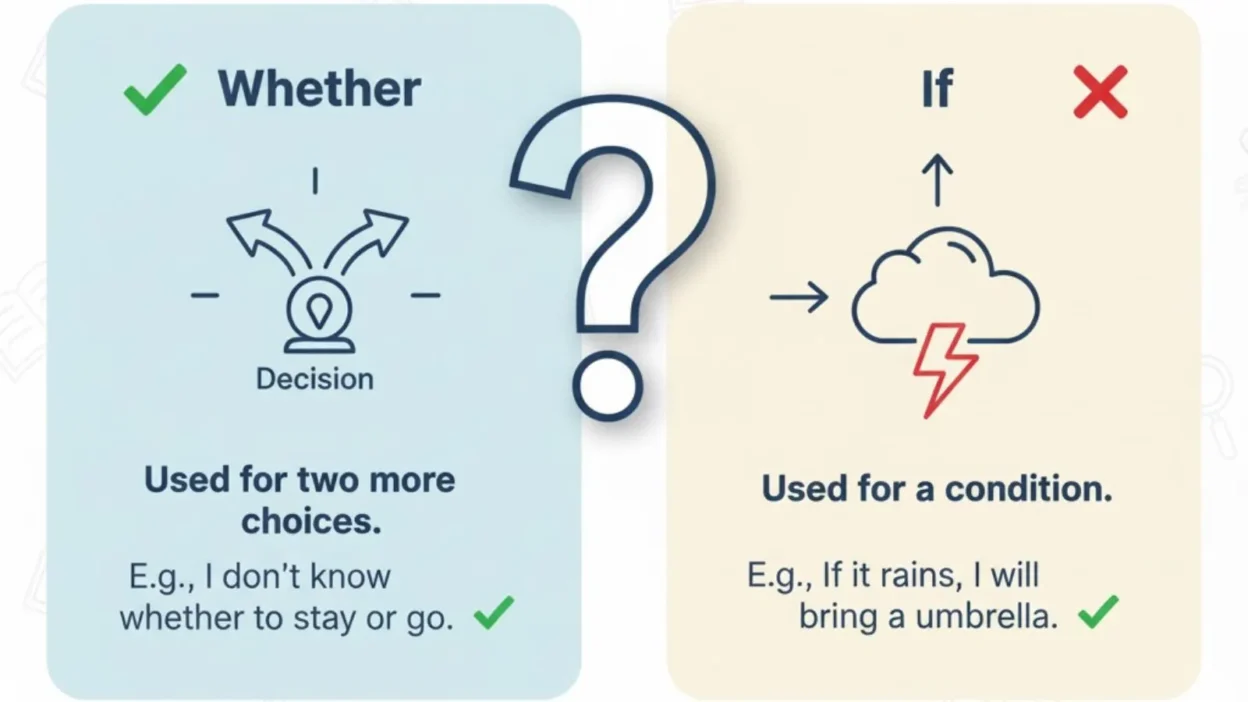
✔️ Use whether when there are two or more options.
Example:
- “I don’t know whether he will come.”
- “Tell me whether you want tea or coffee.”
✔️ Use if when talking about a condition.
Example:
- “I’ll call you if I arrive early.”
Sometimes both are fine:
- “I don’t know whether/if it will rain.”
Quick Rule:
➡️ Choice = whether
➡️ Condition = if
📜 The Origin of “Whether or If”
Whether comes from Old English hwæðer, meaning “which of the two.”
If comes from Old English gif, meaning “on the condition that.”
Because of these roots:
- Whether = choice between options
- If = condition
The confusion exists because modern English slowly merged some uses, but the original meanings still guide formal writing today.
🇬🇧🇺🇸 British English vs American English
There is no spelling difference, but there is a difference in preference:
- American English uses if more often in spoken language.
- British English prefers whether in formal writing.
Comparison Table
| Use Case | British English | American English |
|---|---|---|
| Formal writing | whether | whether |
| Casual speech | if / whether | if |
| With “or not” | whether | whether |
| After prepositions | whether | whether |
🎯 Which Spelling Should You Use?
- Writing for U.S. readers:
Use if for conditions and whether for choices. Americans accept both in casual speech. - Writing for U.K./Commonwealth readers:
Use whether more often, especially in formal or professional texts. - Writing for a global audience:
Use whether when unsure — it is always correct in formal writing.
⚠️ Common Mistakes with “Whether or If”
❌ Wrong:
“I don’t know if or not he will come.”
✔️ Correct:
“I don’t know whether or not he will come.”
❌ Wrong:
“Let me know if you want tea or coffee.”
✔️ Correct:
“Let me know whether you want tea or coffee.”
❌ Wrong:
“I am unsure if to go.”
✔️ Correct:
“I am unsure whether to go.”
📝 “Whether or If” in Everyday Examples
Emails
- “Please confirm whether you can attend the meeting.”
- “Let me know if you need help.”
News
- “The court will decide whether the law is valid.”
Social Media
- “I can’t tell if it’s real or edited 😂.”
Formal Writing
- “Researchers examined whether the change had an effect.”
📊 Google Trends & Usage Data
Google Trends shows that “whether or if” is most searched in:
- 🇮🇳 India
- 🇵🇭 Philippines
- 🇺🇸 United States
- 🇬🇧 United Kingdom
- 🇵🇰 Pakistan
Why so popular?
Because learners want a clear rule for:
- Emails
- Exams
- Formal writing
- Content writing
- Business English
Interest peaks during academic seasons and job-application months.
📌 Keyword Comparison Table
| Keyword | Meaning | Best Use |
|---|---|---|
| whether | choice | formal or clear writing |
| if | condition | everyday speech |
| whether or not | two outcomes | formal clarity |
| whether vs if | grammar topic | search intent keyword |
❓ FAQs
1. Can I use “if” instead of “whether”?
Sometimes yes, but not when there are two choices.
2. Is “whether or not” correct?
Yes. It adds emphasis.
3. Should I use “whether” in formal writing?
Yes. It is always safe.
4. Is there a difference in meaning?
Yes.
- if = condition
- whether = choice
5. Can “whether” start a sentence?
Yes.
“Whether you like it or not, the rule stays.”
6. Which word is more common?
In speech: if
In writing: whether
7. Does spelling change in UK vs US?
No. Only usage differs.
🧠 Conclusion
Choosing between “whether or if” becomes simple once you know the core rule: use whether for choices and if for conditions. Most confusion comes from the fact that people hear both words used in similar sentences. This makes them think the words are interchangeable in every situation—but they are not. ✔️
When in doubt, remember that whether is always correct in formal writing, professional emails, and academic work. On the other hand, if works best in simple conditional sentences, especially in everyday speech. 🌍✍️
Across countries, the usage varies slightly. American English leans toward if, while British English prefers whether in more serious writing. Still, the meaning stays the same worldwide.
Use the tables, examples, and quick rules from this article to guide your writing. With practice, choosing the right word will feel natural—no hesitation, no confusion, and no grammar errors. 🎉
Discover More Articles
- Worshiping or Worshipping Which Spelling Is Right? 2026🙏
- Despite or In Spite Of What’s the Difference? (Full Guide) ✨📚 2026
- 🌟Because of or Due to What’s the Difference? (Complete Guide) ✨📘 2026
- ✨101+Although or Though Which One Should You Use? 2026✨