Every day, millions of people type “Who or Whom?” into Google 🤔.
And there’s a simple reason: this tiny grammar rule confuses almost everyone. Students struggle with it. Professionals avoid it.
Even native speakers sometimes guess the answer hoping they’re right.
Why?
Because who and whom look almost the same, but their use changes based on grammar roles.
And when you’re writing emails, essays, captions, or professional messages, using the wrong one can make your sentence feel awkward or incorrect.
This article will make things super easy for you.
No complicated grammar terms, no confusing explanations—just clear rules, friendly examples, emoji signs, and quick shortcuts you can remember forever. ✨
By the end, you’ll know exactly when to use who and when to use whom, how they differ in British and American English, common mistakes, real-life examples, usage data, and a quick comparison table.
Let’s solve this once and for all! ✔️
Who or Whom – Quick Answer ✔️
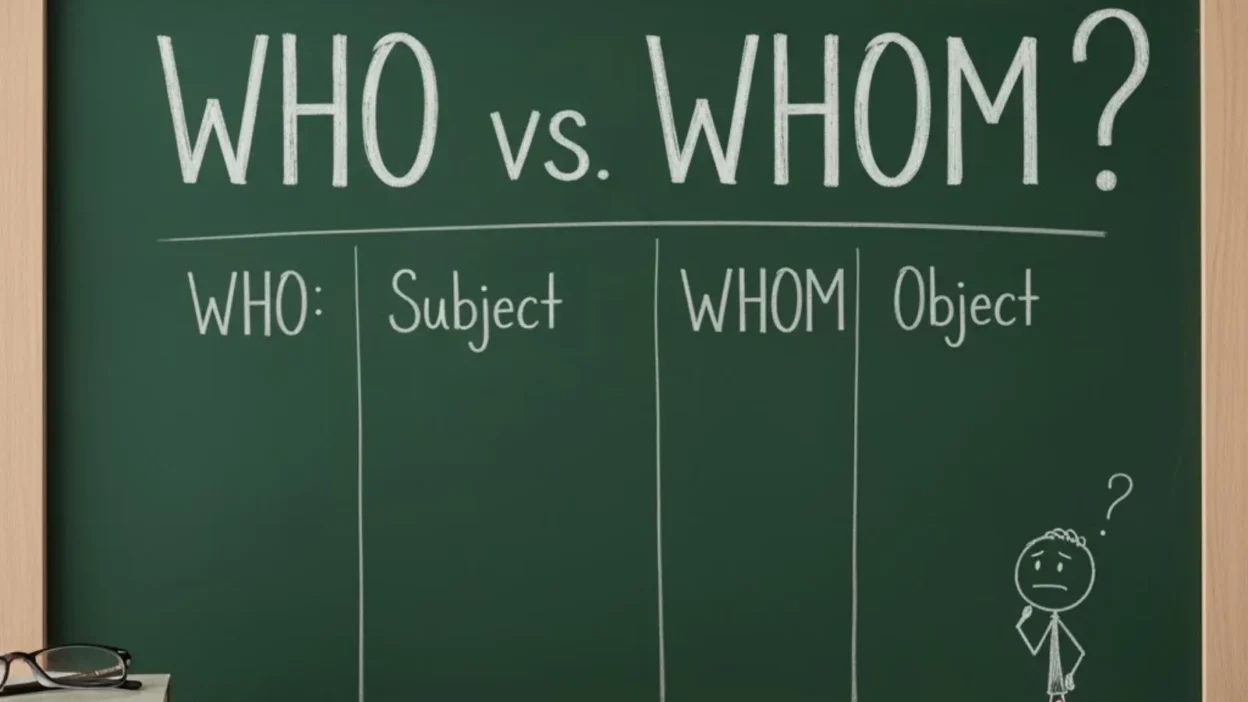
👉 Use who for the subject – the person doing the action.
👉 Use whom for the object – the person receiving the action.
Examples:
- Who called you? 📞 (subject)
- You called whom? 🎯 (object)
- Who is coming to the meeting? 👥
- To whom should I address this letter? ✉️
Quick trick:
If you can replace the word with he / she, use who.
If you can replace it with him/her, use whom.
✔️ Who = he / she
✔️ Whom = him/her
The Origin of “Who or Whom” 📜
The words who and whom come from Old English.
- Who came from hwā (meaning “which person”).
- Whom came from hwām or hwǣm (the object form).
Long ago, English had many word forms depending on grammar cases.
Example:
- He / Him
- She / Her
- Who / Whom
Over time, English dropped most grammar cases. But whom survived—mainly in formal writing. That’s why today whom feels old-fashioned, while who feels natural.
The confusion exists because the forms changed—but the rules stayed. So learning the simple “subject vs object” trick makes everything clear. ✔️
British English vs American English 🇬🇧🇺🇸
Both British and American English use who the same way.
But the difference is in how often they use whom.
American English 🇺🇸
- Uses whom less often
- More comfortable dropping it in casual writing
- Example: “Who should I talk to?” (acceptable)
British English 🇬🇧
- Uses whom more often
- Considered more formal and correct
- Example: “To whom should I speak?” (preferred in formal writing)
Comparison Table
| Aspect | Who | Whom |
|---|---|---|
| Grammar Role | Subject | Object |
| US Usage | Very common | Rare |
| UK Usage | Very common | More common than US |
| Formality | Neutral | Formal |
| Replace With | He/She | Him/Her |
Which Spelling Should You Use? ✔️
It depends on your audience:
If writing for the US 🇺🇸
Use who most of the time.
Use whom only in very formal cases.
If writing for the UK/Commonwealth 🇬🇧🇵🇰🇮🇳🇦🇺
Use whom in:
- Professional emails
- Academic writing
- Government/official documents
Use who in all casual writing.
If writing for a global audience 🌍
Use who, unless the sentence sounds wrong without whom.
Clarity > strict grammar.
Common Mistakes with “Who or Whom” ⚠️
❌ “Whom is coming?”
✔️ Correct: Who is coming? (subject)
❌ “The manager, who I spoke to him, agreed.”
✔️ Correct: The manager whom I spoke to agreed.
❌ “Do you know who to trust?” (actually correct!)
Why? → “Who to trust” sounds natural; whom is too formal.
“Who or Whom” in Everyday Examples 📱✉️📰
- “Please let me know who will attend.”
- “To whom it may concern,”
Social Media
- “Guess who I met today! 😍”
- “Whom are they talking about? 👀” (rare but correct)
News
- “Police are searching for the suspect who fled the scene.”
- “The officer to whom the report was given declined to comment.”
Formal Writing
- “Applicants who meet the criteria may apply.”
- “The person to whom the award was given thanked the committee.”
“Who or Whom” – Google Trends & Usage Data 📊
- “Who” is searched far more than “whom.”
- “Whom” spikes during exam season and grammar tests.
- Countries with the highest search interest:
🇺🇸 USA • 🇬🇧 UK • 🇮🇳 India • 🇵🇰 Pakistan • 🇦🇺 Australia - Most searches come from:
✔️ Students
✔️ Job applicants
✔️ Content writers
✔️ Professionals writing formal emails
Keyword Variations Comparison Table 📌
| Keyword | Meaning | Use Case |
|---|---|---|
| Who | Subject | Questions, statements |
| Whom | Object | Formal writing |
| Who vs Whom | Comparison | Grammar guides |
| When to use whom | Rule-based | Exams, formal letters |
| Who or Whom | Quick answer | Everyday grammar |
FAQs ❓
1. Is “whom” still used today?
Yes, but mostly in formal writing.
2. Is it wrong to use “who” instead of “whom”?
Not always—modern English accepts “who” in many informal cases.
3. How do I know quickly which one to use?
Replace the word with he / she (who) or him/her (whom).
4. Do native speakers use “whom”?
Rarely, except in formal writing.
5. Why is “To whom it may concern” correct?
Because “whom” is the object of the preposition to.
6. Should I teach children “whom”?
Yes, but teach it as formal grammar.
7. Is “Whom did you see?” correct?
Yes, but many people say: “Who did you see?”
Conclusion
The confusion between who and whom has lasted for centuries, but the solution is simple: who is the subject, and whom is the object. If it fits with him or her, choose whom. This small rule solves almost every problem you will face.
Modern English accepts “who” in many cases where “whom” was once required. That’s why social media posts, emails, and everyday conversations use “who” almost all the time. Still, whom remains important in formal writing, academic papers, job applications, legal documents, and professional letters.
Choose based on your audience:
Use “who” for casual writing and global readers, but keep “whom” for official or traditional contexts.
With practice, these two words will feel natural. The more you read and write them, the clearer they become. Now you can use both with confidence—any time, anywhere, in any style. ✔️
Discover More Articles
- ⭐ Principal or Principle What’s the Difference? (Easy Guide + Examples) 2026
- ✨ Complement or Compliment What’s the Difference? ✨2026
- 🌍 Further or Farther What’s the Right Word to Use? 2026
- 🌟 Altogether or All together What’s the Difference & When to Use Each? 2026